



Frying Panoramas
What’s this then? Jovian moon? Instagrammed photo of Earth taken from the ISS? Head of a nail?
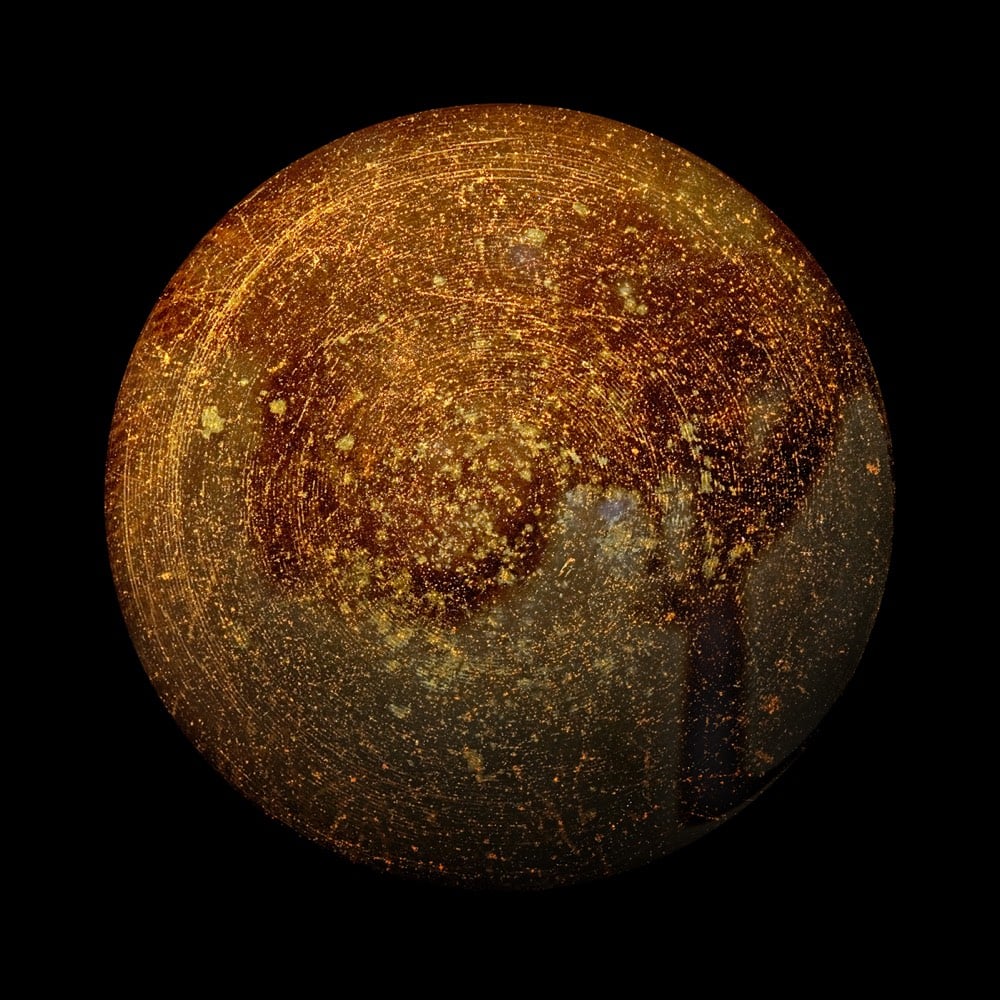
Nope, it’s actually a well-worn frying pan from a project by Christopher Jonassen.

This site is made possible by member support. 💞
Big thanks to Arcustech for hosting the site and offering amazing tech support.
When you buy through links on kottke.org, I may earn an affiliate commission. Thanks for supporting the site!
kottke.org. home of fine hypertext products since 1998.
Beloved by 86.47% of the web.
What’s this then? Jovian moon? Instagrammed photo of Earth taken from the ISS? Head of a nail?
Nope, it’s actually a well-worn frying pan from a project by Christopher Jonassen.
In a 2008 paper called The Seductive Allure of Neuroscience Explanations, a group from Yale University demonstrated that including neuroscientific information in explanations of psychological phenomena makes the explanations more appealing, even if the neuroscientific info is irrelevant.
Explanations of psychological phenomena seem to generate more public interest when they contain neuroscientific information. Even irrelevant neuroscience information in an explanation of a psychological phenomenon may interfere with people’s abilities to critically consider the underlying logic of this explanation.
I don’t know if I buy this. Perhaps if the authors had explained their results relative to how the human brain functions…
The standard form of Soviet war correspondence during WWII were letters folded into a triangular shape.
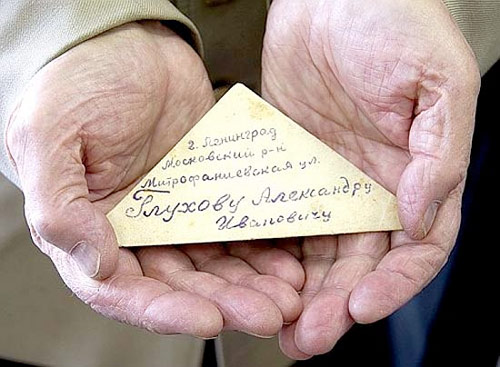
During the war, the mails were brought for free from the front to home. It could not have been differently, because probably the postage stamps would have been the last item the halting logistic support would have delivered to the front. Even so, postcards and envelopes were shortages. The soldiers’ genius has thus created, right in the first months of the war, the format that was a letter and its own envelope in one. The folding process is very similar to how we, in our childhood, folded our soldier’s shako, knowing nothing about the triangular soldier’s letters.
(via raul)
A lovely collection of hand-lettered American department store logos from the late 19th and early 20th century.
Here’s the entire source code + helpful annotations for the original Metroid game for the NES.
Labels corresponding to address values have been added to every line to make the code easier to follow for beginners interested in understanding the inner workings of a Nintendo game. The labels also make the code easier to debug if it is modified. At this time, the source code is still a work in progress but it is much farther along than the original document. The title page is completely documented. The intro routine, end routine, password scheme and sound engine are described in detail. About a third of the game engine is detailed and about half of each game area page.
(via @shauninman)
You’re given a name and you have to guess if it’s a cheese or a font. This might be the most difficult game I’ve ever played. (thx, @ziggy444)
A very raw and passionate post by former Amazon employee and current Google employee Steve Yegge in which he praises a key decision made by Amazon several years ago to build a platform…and argues that a major problem for Google going forward is a lack of a platform of their own. It starts off:
I was at Amazon for about six and a half years, and now I’ve been at Google for that long. One thing that struck me immediately about the two companies — an impression that has been reinforced almost daily — is that Amazon does everything wrong, and Google does everything right. Sure, it’s a sweeping generalization, but a surprisingly accurate one. It’s pretty crazy. There are probably a hundred or even two hundred different ways you can compare the two companies, and Google is superior in all but three of them, if I recall correctly. I actually did a spreadsheet at one point but Legal wouldn’t let me show it to anyone, even though recruiting loved it.
I mean, just to give you a very brief taste: Amazon’s recruiting process is fundamentally flawed by having teams hire for themselves, so their hiring bar is incredibly inconsistent across teams, despite various efforts they’ve made to level it out. And their operations are a mess; they don’t really have SREs and they make engineers pretty much do everything, which leaves almost no time for coding - though again this varies by group, so it’s luck of the draw. They don’t give a single shit about charity or helping the needy or community contributions or anything like that. Never comes up there, except maybe to laugh about it. Their facilities are dirt-smeared cube farms without a dime spent on decor or common meeting areas. Their pay and benefits suck, although much less so lately due to local competition from Google and Facebook. But they don’t have any of our perks or extras — they just try to match the offer-letter numbers, and that’s the end of it. Their code base is a disaster, with no engineering standards whatsoever except what individual teams choose to put in place.
This is the contemporary take on the guy-meets-girl-at-party story. Guy isn’t particularly interested in girl but at some later point starts surreptitiously taking photos of her and posting them to a secret blog. Girl finds out, isn’t creeped out at all. Boy doesn’t feel shame at girl’s discovery, only that it ruined his creative outlet before “he might have gotten better at it or something”. Girl decides to interview boy for her communications class. You know, completely normal.
She messaged Walker through Facebook, and at first he seemed receptive. “He thought it was funny,” said Merker. But after an initial show of interest, Walker got skittish, canceling and rescheduling the interview repeatedly. When Merker finally sat down with him, it was only after she had managed to catch him off-guard, saying she was already in his neighborhood and offering to meet at a bar.
Walker had one condition: he wanted to do the interview “in character” as the persona he had established through the blog. That would mean interviewing Merker, too; after all, any blogger who had devoted an entire Tumblr to a single person would certainly take the opportunity to directly question his subject.
You know when Mark Zuckerberg says stuff like privacy doesn’t matter and Facebook makes formerly private information public without notice and all the tech pundits (most of whom are older than Zuck) go bananas tearing out their hair about how stupid and crazy that is? Now you know where Zuck and Facebook are coming from.
Dennis Richie passed away last week. Richie created the C programming language, was a key contributer to UNIX, and wrote an early definitive work on programming, The C Programming Language.
We lost a tech giant today. Dennis MacAlistair Ritchie, co-creator of Unix and the C programming language with Ken Thompson, has passed away at the age of 70. Ritchie has made a tremendous amount of contribution to the computer industry, directly and indirectly affecting (improving) the lives of most people in the world, whether you know it or not.
These sorts of comparisons are inexact at best, but Richie’s contribution to the technology industry rivals that of Steve Jobs’…Richie’s was just less noticed by non-programmers.
Dan Lyons posted the notes of a long conversation he had with Steve Wozniak last week. Lots of Apple history and prehistory…I didn’t know, for instance, that Woz designed the Apple I before Jobs was involved.
I was highly regarded for my engineering skills. But I never wanted money. I would have been a bad person to run a company. I wanted to be a nice guy. I wanted to make friends with everybody. Yes I came up with the idea for the personal computer but I don’t want to be known as a guy who changed the world. I want to be known as an engineer who connected chips in a really efficient way or wrote code that is unbelievable. I want to be known as a great engineer. I’m thankful Steve Jobs was there. You need someone who has a spirit for the marketplace. Who has the spirit for who computers change humanity. I didn’t design the Apple II for a company. I designed it for myself, to show off. I look at all the recent Apple products, like the iPhone, the iPad, and even Pixar, and it was like everything Steve worked on had to be perfect. Because it was him. Every product he created was Steve Jobs.
And Woz is *still* an Apple employee! He makes $100 a week. (via stellar)
Fuck Yeah Made in USA is a collection of videos showcasing products that are made in the US. These are chock full of “how things are made” goodness.
A version of Food Rules by Michael Pollan illustrated by Maira Kalman? Hell yeah!
Michael Pollan and Maira Kalman come together to create an enhanced Food Rules for hardcover, now beautifully illustrated and with even more food wisdom.
Michael Pollan’s definitive compendium, Food Rules, is here brought to colorful life with the addition of Maira Kalman’s beloved illustrations.
This brilliant pairing is rooted in Pollan’s and Kalman’s shared appreciation for eating’s pleasures, and their understanding that eating doesn’t have to be so complicated. Written with the clarity, concision, and wit that is Michael Pollan’s trademark, this indispensable handbook lays out a set of straightforward, memorable rules for eating wisely. Kalman’s paintings remind us that there is delight in learning to eat well.
The short answer is “you can’t” but the longer answer by a former patrol officer is more interesting.
How often do you drive in this manner? Unless you’re running because you’re on parole, this is likely your first dance. Sure, you’ve driven fast before — for a while. Then, for whatever reason, you got uncomfortable and backed off. Maybe your car made a sound you got concerned about, maybe you caught a glint you thought might be a trooper’s windshield, maybe you thought you heard the faintest pulses of a siren. Whatever it was, it weakened your resolve and you slowed down. You have no such luxury here. And while this is fresh for you, this is, to many of the people pursuing you, another day another dollar. They’ve trained for this in training scenarios and have been involved in pursuits in the field. They run code multiple times a week. Even if one of your pursuers was a rookie who got eaten up by the stress, there will be a dozen vets to take his place.
(thx, byrne)
Kern Type is a game that compares your kerning efforts to those of professional designers. It’s surprisingly fun. (thx, damien)
Artist and filmmaker Miranda July used to shoplift as sort of a useful hobby.
But it wasn’t just about the supermarket — the whole world was one giant heist. It goes without saying that I used magnets to reset the Kinko’s copy counters to zero, and carried scissors to cut alarm tags out of clothes. Everyone I knew did these things. I say this not to excuse myself but just so you can visualize a legion of energetic, intelligent young lady criminals. Anytime anyone we knew flew into Portland, we urged her to buy luggage insurance and allow us to steal her bag from the baggage carrousel. The visiting friend then had to perform the role of the frantic claims reporter and was given a cut of the insurance money. Some friends were up for this; others thought it was an inhospitable thing to ask.
Scientists have developed a spray gun that sprays the burn victim’s own skin cells onto the affected area heals them within a matter of days, not weeks or months.
The guy doesn’t even look like he got burned. (via @delfuego)
Ed Levine and the crew over at Serious Eats are coming out with a book that attempts to distill the last five years of the web site into book form. Serious Eats: A Comprehensive Guide to Making and Eating Delicious Food Wherever You Are comes out in early November.
Ed Levine, whom Ruth Reichl calls the “missionary of the delicious,” and his SeriousEats.com editors present their unique take on iconic foods made and served around the country. From house-cured, hand-cut corned beef sandwiches at Jake’s in Milwaukee to fried-to-order doughnuts at Shipley’s Do-Nuts in Houston; from fresh clam pizza at Zuppardi’s Pizzeria in West Haven, Connecticut, to Green Eggs and Ham at Huckleberry Bakery and Caf’e in Los Angeles, Serious Eats is a veritable map of some of the best food they have eaten nationwide.
Covering fast food, family-run restaurants, food trucks, and four-star dining establishments, all with zero snobbery, there is plenty here for every food lover, from coast to coast and everywhere in between. Featuring 400 of the Serious Eats team’s greatest food finds and 50 all-new recipes, this is your must-read manual for the pursuit of a tasty life.
You’ll learn not only where to go for the best grub, but also how to make the food you crave right in your own kitchen, with original recipes including Neapolitan Pizza (and dough), the Ultimate Sliders (which were invented in Kansas), Caramel Sticky Buns, Southern Fried Chicken, the classic Reuben, and Triple-Chocolate Adult Brownies. You’ll also hone your Serious Eater skills with tips that include signs of deliciousness, regional style guides (think pizza or barbecue), and Ed’s hypotheses-ranging from the Cuban sandwich theory to the Pizza Cognition Theory-on what makes a perfect bite.
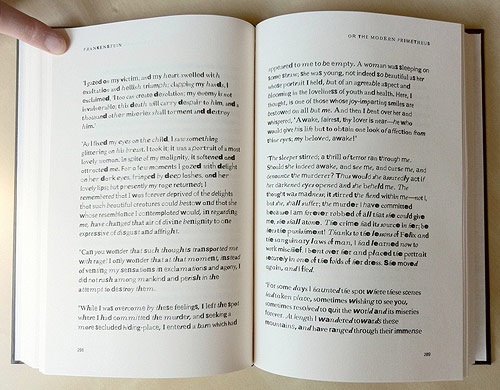
From Fathom, a copy of Mary Shelley’s Frankenstein constructed from found type on the web…as the book goes on, the type gets less legible.
The incomplete fonts found in the PDFs were reassembled into the text of Frankenstein based on their frequency of use. The most common characters are employed at the beginning of the book, and the text devolves into less common, more grotesque shapes and forms toward the end.
Internet sensation Amit Gupta was recently diagnosed with leukemia and needs a bone marrow transplant. Problem is that he needs a transplant from someone of South Asian descent.
To aid him in his fight, Amit is going to need a bone marrow transfusion. Unlike blood transfusions, finding a genetic match for bone marrow that his body will accept is no easy task. The national bone marrow registry has 9.5 million records on file, yet the chances of someone from South Asian descent of finding a match are only 1 in 20,000.
This is where we come in. We’re going to destroy those odds.
How? By finding and registering as many people of South Asian descent as we possibly can.
Tests are easy — a simple swab of the cheek. If someone is determined to be a match, that person would have to be willing to undergo an outpatient procedure in which marrow is extracted from bones in the back by a special needle. It’s not a fun procedure, but it’s not dangerous either. And doing it could save a life.
If you’re interested in helping, read on.
I am incredibly sad this morning. Why am I, why are we, feeling this so intensely? I have some thoughts about that but not for now. For now, I’m just going to share some of the things I’ve been reading and watching about Jobs. And after that, I think I’m done here for the day and will move on to spend some time building my little thing that I’m trying to make insanely great.
The 2005 Stanford Commencement Speech. For me, the speech is better in text than in video.
Your time is limited, so don’t waste it living someone else’s life. Don’t be trapped by dogma - which is living with the results of other people’s thinking. Don’t let the noise of others’ opinions drown out your own inner voice. And most important, have the courage to follow your heart and intuition. They somehow already know what you truly want to become. Everything else is secondary.
The iPhone announcement in 2007. I am with Dan Frommer on this one: this is Jobs at his absolute best. He was just so so excited about this thing that he and his team had created, so proud. His presentation is also a reminder of how revolutionary the iPhone was four years ago.
Here’s to the crazy ones… Here’s a version of the famous Think Different commercial narrated by Steve Jobs…it never aired on TV.
Compare to the aired version with Richard Dreyfuss narrating.
Steven Levy on Jobs. Levy covered Apple and Jobs extensively for many years; his obit is a good one.
Jobs usually had little interest in public self-analysis, but every so often he’d drop a clue to what made him tick. Once he recalled for me some of the long summers of his youth. I’m a big believer in boredom,” he told me. Boredom allows one to indulge in curiosity, he explained, and “out of curiosity comes everything.” The man who popularized personal computers and smartphones — machines that would draw our attention like a flame attracts gnats — worried about the future of boredom. “All the [technology] stuff is wonderful, but having nothing to do can be wonderful, too.”
Steve Jobs’ grass-stained shoes. Damn you Gruber for making me tear up like that.
I like to think that in the run-up to his final keynote, Steve made time for a long, peaceful walk. Somewhere beautiful, where there are no footpaths and the grass grows thick. Hand-in-hand with his wife and family, the sun warm on their backs, smiles on their faces, love in their hearts, at peace with their fate.
Steve Jobs rainbow over Pixar. What does it mean?
Moments after news broke about Steve Jobs’ death, a rainbow popped out of the Pixar campus (taken with my iPhone 4). Rest in peace, Steve, and thank you.
Jobs testing Photo Booth filters. Perhaps these aren’t the best photos ever taken of Steve Jobs, but they are among my favorites.
Walt Mossberg remembers his friend. Among journalists, few knew Jobs as well as Mossberg; he shares his stories and tribute here.
I have no way of knowing how Steve talked to his team during Apple’s darkest days in 1997 and 1998, when the company was on the brink and he was forced to turn to archrival Microsoft for a rescue. He certainly had a nasty, mercurial side to him, and I expect that, then and later, it emerged inside the company and in dealings with partners and vendors, who tell believable stories about how hard he was to deal with.
But I can honestly say that, in my many conversations with him, the dominant tone he struck was optimism and certainty, both for Apple and for the digital revolution as a whole. Even when he was telling me about his struggles to get the music industry to let him sell digital songs, or griping about competitors, at least in my presence, his tone was always marked by patience and a long-term view. This may have been for my benefit, knowing that I was a journalist, but it was striking nonetheless.
At times in our conversations, when I would criticize the decisions of record labels or phone carriers, he’d surprise me by forcefully disagreeing, explaining how the world looked from their point of view, how hard their jobs were in a time of digital disruption, and how they would come around.
This quality was on display when Apple opened its first retail store. It happened to be in the Washington, D.C., suburbs, near my home. He conducted a press tour for journalists, as proud of the store as a father is of his first child. I commented that, surely, there’d only be a few stores, and asked what Apple knew about retailing.
He looked at me like I was crazy, said there’d be many, many stores, and that the company had spent a year tweaking the layout of the stores, using a mockup at a secret location. I teased him by asking if he, personally, despite his hard duties as CEO, had approved tiny details like the translucency of the glass and the color of the wood.
He said he had, of course.
4 Steve. Loved this tweet:
From now on, the “4S” is going to stand for, “For Steve.” #apple
Dada. Oh and this one from Neven Mrgan too:
Heartwarming/breaking: shortly following the news of Steve’s death, our daughter called me “dada” for the first time. It goes on.
The Computer That Changed My Life. Bryce Roberts shares the story of the first Apple computer he bought.
As I sat alone in my makeshift office in Sandy, UT I decided that I wanted to start fresh, all the way down to my operating system. It sounds funny now, but it was an important psychological move for me. I wanted the next level to look and feel different than what I’d experienced in the past in every possible way.
I fired up my Sony Viao and surfed over to Apple.com. I wasn’t an Apple fanboy. I’d never owned one of their machines. And that was the point.
I didn’t know if I would love it or even like it, but it was going to be different. And different was exactly how I wanted the next level to feel.
This is *exactly* why I bought an iBook in 2002 after a lifetime of Windows/DOS machines.
Statement from Bill Gates. It really says something about a person when once-bitter rivals become friends later in life.
For those of us lucky enough to get to work with him, it’s been an insanely great honor. I will miss Steve immensely.
Apple’s homepage. Pitch-perfect tribute. Archive here.
Brian Lam apologies to Steve Jobs for being an asshole. If you followed the whole Gizmodo/iPhone thing, this is worth a read.
I was on sabbatical when Jason got his hands on the iPhone prototype.
An hour after the story went live, the phone rang and the number was from Apple HQ. I figured it was someone from the PR team. It was not.
“Hi, this is Steve. I really want my phone back.”
He wasn’t demanding. He was asking. And he was charming and he was funny. I was half-naked, just getting back from surfing, but I managed to keep my shit together.
And from the kottke.org archives, the 60+ posts I’ve made over the years about Jobs.
A common reaction to Apple’s announcement of the iPhone 4S yesterday was disappointment…Mat Honan’s post at Gizmodo for instance.
I was hoping for something bold and interesting looking. The iPhone 4 was just that when it shipped. So too were the original iPhone and the iPhone 3G. If I’m going to buy a new phone, of course I want it to look new. Because of course we care about having novel designs. If we didn’t we’d all be lugging around some 10-inch thick brick with a 12 day battery life.
Mat’s is an understandable reaction. After I upgraded my iPhone, Macbook Pro, and OS X all at once two years ago, I wrote about Apple’s upgrade problem:
From a superficial perspective, my old MBP and new MBP felt exactly the same…same OS, same desktop wallpaper, same Dock, all my same files in their same folders, etc. Same deal with the iPhone except moreso…the iPhone is almost entirely software and that was nearly identical. And re: Snow Leopard, I haven’t noticed any changes at all aside from the aforementioned absent plug-ins.
So, just having paid thousands of dollars for new hardware and software, I have what feels like my same old stuff.
Deep down, when I stop to think about it, I know (or have otherwise convinced myself) that these purchases were worth it and that Apple’s ease of upgrade works almost exactly how it should. But my gut tells me that I’ve been ripped off. The “newness” cognitive jolt humans get is almost entirely absent.
For me, yesterday’s event, Apple’s continued success in innovation *and* business, and the recent CEO change provided a different perspective: that Apple makes two very complementary types of products and we should be excited about both types.
The first type of product is the most familiar and is exemplified by Steve Jobs: Apple makes magical products that shape entire industries and modify social structures in significant ways. These are the bold strokes that combine technology with design in a way that’s almost artistic: Apple II, Macintosh, iPod, iPhone, and iPad. When they were introduced, these products were new and exciting and no one quite knew where those products were going to take us (Apple included). That’s what people want to see when they go to Apple events: Steve Jobs holding up a rainbow-hued unicorn that you can purchase for your very own.
The second type of product is less noticed and perhaps is best exemplified by Apple’s new CEO, Tim Cook: identify products and services that work, continually refine them, innovate at the margins (the addition of Siri to the iPhone 4S is a good example of this), build interconnecting ecosystems around them, and put processes and infrastructure in place to produce ever more of these items at lower cost and higher profit. The wheel has been invented; now we’ll perfect it. This is where Apple is at with the iPhone now, a conceptually solved problem: people know what they are, what they’re used for, and Apple’s gonna knuckle down and crank out ever better/faster/smarter versions of them in the future. Many of Apple’s current products are like this, better than they have ever been, more popular than they have ever been, but there’s nothing magical about them anymore: iPhone 4S, iPod, OS X, iMacs, Macbooks, etc.
The exciting thing about this second type of product, for investors and consumers alike, is Apple is now expert at capturing their lightning in a bottle. ‘Twas not always so…Apple wasn’t able to properly capitalize on the success of the Macintosh and it almost killed the company. What Tim Cook ultimately held up at Apple’s event yesterday is a promise: there won’t be a return to the Apple of the 1990s, when the mighty Macintosh devolved into a flaky, slow, and (adding insult to injury) expensive klunker and they couldn’t decide on a future direction for their operating system (remember Copland?). There will be an iPhone 5 in the future and it will be better than the iPhone 4S in significant & meaningful ways but it will also *just work*. And while that might be a bit boring to Apple event watchers, this interconnected web of products is the thing that makes the continued development of the new and magical products possible.
In 1987, Apple made a video showcasing a concept they called Knowledge Navigator:
The crazy thing is that the year in the video is 2011…and Apple announced something very much like Knowledge Navigator (Siri, a natural language voice assistant) at their event yesterday. (via waxy)
Not sure if it’ll stay like this, but what a great idea for a gadget site for normal people: a list of recommended technology products broken down into categories based on how people actually make buying decisions. Sample categories include Best Laptop Ever Created, The Great TV I’d Get, and Best Wireless Carrier.
Richard Feynman talking about the beauty of science and of the natural world over a bunch of video footage taken from NASA, Microcosmos, and BBC nature docs like Planet Earth? This is fantastically right up my alley.
Part two is Honours and part three is Curiosity. If I ever go on hallucinogenic walkabout in the desert, I’d want Richard Feynman to be my spirit animal. (via ★interesting)
If you missed the cast reunion of Arrested Development at the New Yorker festival over the weekend, you can watch the whole thing on Facebook here (you must be logged in to see the video). This is the event at which they announced that the show will be coming back.
When I heard the news, my immediate reaction was not positive. There may have been an expletive uttered. I am happy for the crew at Typekit, several of whom are my friends, but Adobe products do not fill me with joy when I use them. No one I know is filled with joy when using Adobe products…mostly the opposite. Typekit is a great service; I hope Adobe keeps it that way.
Premiering on HBO this week, a Martin Scorsese documentary on George Harrison, everyone’s favorite Beatle who wasn’t John or Paul.
Academy Award-winning director Martin Scorsese traces Harrison’s live from his musical beginnings in Liverpool though his life as a musician, a seeker, a philanthropist and a filmmaker, weaving together interviews with Harrison and his closest friends, performances, home movies and photographs. Much of the material in the film has never been seen or heard before. The result is a rare glimpse into the mind and soul of one of the most talented artists of his generation and a profoundly intimate and affecting work of cinema.
Title Scream is a collection of 8-bit video game title screens. Not just static images either…animated GIFs, yo.
You’ve never seen a literally slack jaw until you’ve seen a four-year-old watching Empire Strikes Back for the first time and learning that Darth Vader is Luke’s father.
Kim Noble, although she doesn’t care to be called that, has over 100 distinct personalities.
For a journalist, this presents certain problems. Kim Noble herself is merely a name on a birth certificate - a portmanteau of identities. So which version of her do you interview? Do you talk to whomever pops up? Hayley? Judy? Ken?
It turns out there’s a protocol: you meet Patricia, the dominant personality among the many alter egos in Noble’s head. With the help of regular support workers, Patricia looks after Aimee and makes sure there’s milk in the fridge. It is Patricia who answers the door and welcomes me in.
A horrifying and fascinating story. Noble wrote a book about her experiences and the varied body of art done by her various personalities can be seen here. And do watch this video; it’s a clip of one of Noble’s personality switches…the language she uses to describe herselves is interesting. (via @dunstan)
Today at the New Yorker Festival, the entire cast of Arrested Development gathered for the first time since the show wrapped in 2005 and the big news was:
If all goes according to plan, the series will return to television in a nine- or ten-episode limited-run television series, set to film next summer, with each episode focussing on a single member of the Bluth clan. And series creator Mitchell Hurwitz said that he is halfway through the screenplay for a reunion film and is “eighty per cent” sure it will happen.
!!!!

Socials & More