


Found functions
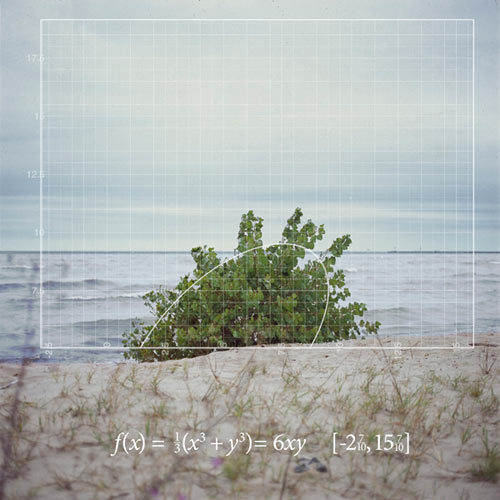
Photographs of curves found in nature and the graphs and functions that go with them.
(via snarkmarket)

This site is made possible by member support. 💞
Big thanks to Arcustech for hosting the site and offering amazing tech support.
When you buy through links on kottke.org, I may earn an affiliate commission. Thanks for supporting the site!
kottke.org. home of fine hypertext products since 1998.
Beloved by 86.47% of the web.
Photographs of curves found in nature and the graphs and functions that go with them.
(via snarkmarket)
Timothy McSweeney, after whom the McSweeney’s literary magazine and web site are named, died late last month.
As a young man, Timothy was an artist of tremendous talent. The canvases he leaves behind are filled with haunting and beautiful imagery. They are also filled with a palpable desire-to be heard, to connect, to be understood better by others and himself. The letters that inspired this journal’s name were a continuation of that same lifelong effort to more intimately know the world and his place within it.
Dave Eggers tells the story of the real Timothy McSweeney and why he named the magazine after him.
A collection of upside down faces presented as if they were right side up.

I like best the ones where the hair doesn’t give it away and you have to look to the cheeks or the eyes for evidence of upside down-ness. (via @brainpicker)
An experiment to detect gravitational waves may indicate that our universe is a holographic projection.
If this doesn’t blow your socks off, then Hogan, who has just been appointed director of Fermilab’s Center for Particle Astrophysics, has an even bigger shock in store: “If the GEO600 result is what I suspect it is, then we are all living in a giant cosmic hologram.” […] Our everyday experience might itself be a holographic projection of physical processes that take place on a distant, 2D surface.
My socks have been blown so far off they are in a parallel universe. We might be living in the shadow of Flatland. Read the whole thing…it’s noodle-bending throughout. Reminds me of the discovery of cosmic background radiation. (via aegirthor)
What if the Super Bowl was directed by Wes Anderson or Quentin Tarantino? You’d get something like this. The Werner Herzog bit at the end is great.
They include camping gear, Hyundai cars, and upscale generic products. (via mr)
The US National Archives have added a number of photos to the Flickr Commons project. Flickr is quietly building the greatest collection of historical documents on the web.
Recent evidence of horizontal gene transfer — in which genes are exchanged from other organisms, not from ancestors — has some scientists thinking that the dominant form of evolution for most of the Earth’s history was between non-related organisms and not among ancestors.
In the past few years, a host of genome studies have demonstrated that DNA flows readily between the chromosomes of microbes and the external world. Typically around 10 per cent of the genes in many bacterial genomes seem to have been acquired from other organisms in this way, though the proportion can be several times that. So an individual microbe may have access to the genes found in the entire microbial population around it, including those of other microbe species. “It’s natural to wonder if the very concept of an organism in isolation is still valid at this level,” says Goldenfeld.
Read on for their hypothesis about how horizontal evolution drove innovation — development of a universal genetic code and genetic innovation-sharing protocols — in life forms early on in the Earth’s history. Fascinating.
A snail that lives near the hydrothermal vents in the Indian Ocean has developed an unusual defense mechanism: it uses the iron sulfide in the surrounding water to make an iron-plated shell with some interesting properties.
Part of its ability to resist damage seems to be the way the shell deforms when it’s struck: It produces cracks that dissipate the force of the blow, and nanoparticles that injure whatever is attacking it
Using brain scanning equipment and a cleverly designed interrogation technique, scientists have been able to ask questions of so-called vegetative patients; one of them even answered yes or no questions:
Several times when Subject 23 was asked to imagine playing tennis, Monti said, the region of the brain most closely associated with complex motor planning became highly active, and stayed active for 30 seconds after researchers prompted such imagery by saying “tennis.”
Similarly, when researchers asked the patient to imagine walking through the house where he grew up and then said the word “navigate,” Subject No. 23 responded with bursts of activity in the region of the brain involved in constructing and navigating a mental map.
The young, French-speaking man was the only subject who was then trained to answer simple yes or no questions — whether his father’s name was Paul (yes) or Alexander (no), whether he had siblings and how many — using the imagery technique he had already learned.
Checking the patient’s responses for accuracy and comparing them to the yes-no brain responses of a group of healthy volunteers, researchers discerned that Subject No. 23 was not only still “in there,” but capable of purposeful thought and communication.
Three out of the top 40 Hollywood earners for 2009 are the 20-something stars of the Harry Potter films…Daniel Radcliffe is sixth on the list, below James Cameron but above Jerry Bruckheimer. Robert Pattinson makes the list at #35 (Kristen Stewart is at #37)…I expect those totals will go up if the Twilight films continue to do well.
Martin Becka and Cedric Delsaux are a pair of photographers who feature Burj Dubai in their work. Becka’s Burj comes from his Dubai, Transmutations project in which he uses the photogravure processing technique to make images of brand-new Dubai that look as though they were taken in 1880.

Delsaux’s Burj image comes from a project called The Dark Lens, which features images of Star Wars characters populating the circa-2008 Earth. I believe that’s the Millennium Falcon docking at the Burj:
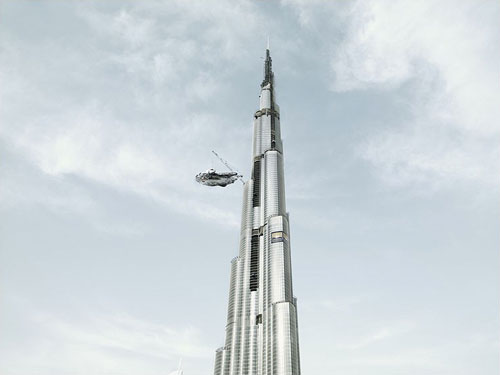
Many more of The Dark Lens images are available on Delsaux’s site.
Omar Hammami was a fairly normal kid from a small town in Alabama — “as a teenager, his passions veered between Shakespeare and Kurt Cobain, soccer and Nintendo” — who is now in Somalia, leading terrorist attacks for a group called Shabab, which is loosely affiliated with Al Qaeda.
In the three years since Hammami made his way to Somalia, his ascent into the Shabab’s leadership has put him in a class of his own, according to United States law-enforcement and intelligence officials. While other American terror suspects have drawn greater publicity, Hammami exercises a more powerful role, commanding guerrilla forces in the field, organizing attacks and plotting strategy with Qaeda operatives, the officials said. He has also emerged as something of a jihadist icon, starring in a recruitment campaign that has helped draw hundreds of foreign fighters to Somalia. “To have an American citizen that has risen to this kind of a rank in a terrorist organization - we have not seen that before,” a senior American law-enforcement official said earlier this month.
See also a New Yorker article about Adam Gadahn, an American who is now a member of Al Qaeda.
A 1970 interview with photographer Garry Winogrand on how he’s not trying to say anything with his work. Instead, he sets up photographic challenges for himself, which he then attempts to solve.
My only interest in photographing is photography.
Those funny double-meaning headlines — like “Gator Attacks Puzzle Experts” or “McDonald’s Fries the Holy Grail for Potato Farmers” — now have a name: crash blossoms. (thx, paolo)
Garry Kasparov discusses the very interesting history and evolution of machines playing against humans in chess.
The heavy use of computer analysis has pushed the game itself in new directions. The machine doesn’t care about style or patterns or hundreds of years of established theory. It counts up the values of the chess pieces, analyzes a few billion moves, and counts them up again. (A computer translates each piece and each positional factor into a value in order to reduce the game to numbers it can crunch.) It is entirely free of prejudice and doctrine and this has contributed to the development of players who are almost as free of dogma as the machines with which they train. Increasingly, a move isn’t good or bad because it looks that way or because it hasn’t been done that way before. It’s simply good if it works and bad if it doesn’t. Although we still require a strong measure of intuition and logic to play well, humans today are starting to play more like computers.
The section about people using computers *during* matches is particularly interesting.
Freefall survival tips orig. from Jun 06, 2008
Aerial map of NYC from 1924 orig. from Feb 01, 2010
First two minutes of Lost season six orig. from Feb 01, 2010
The elements of the incendiary blog post orig. from Feb 02, 2010
* Q: Wha? A: These previously published entries have been updated with new information in the last 24 hours. You can find past updates here.
From Casey Reas, a quick Chrome-only mouse-only game called Twitch. (thx, david)
Comedian Mark Malkoff set out to disprove that New Yorkers are unfriendly and unhelpful by cajoling people into carrying him the length of Manhattan.
Hilarious. He made it all the way up to 141st St & Broadway! (thx, micah)
Hmm, I missed this when it came out last year: An Edible History of Humanity by Tom Standage. Standage has a post on his blog with more information about the book.
The World Meteorological Organization recently released a report saying that Mt. Washington’s world record 231 mph wind gust was exceeded by a 253 mph wind measured in 1996 during a typhoon. (thx, mouser)
I really can’t do a good job, any job, of explaining magnetic force in terms of something else you’re more familiar with, because I don’t understand it in terms of anything else you’re more familiar with.
This is why science is so maddening for some and so great for others.
If you’re looking to drive a lot of traffic to your blog with controversial posts, here’s your template.
This sentence contains a provocative statement that attracts the readers’ attention, but really only has very little to do with the topic of the blog post. This sentence claims to follow logically from the first sentence, though the connection is actually rather tenuous. This sentence claims that very few people are willing to admit the obvious inference of the last two sentences, with an implication that the reader is not one of those very few people.
The comments are worth a read too. (thx, mira)
Update: See also Charlie Brooker on How To Report the News. (thx, christian)
I couldn’t find the entire first hour of the season six premiere of Lost that was supposed to have leaked online, but this contains the first two minutes (plus two minutes from last season):
Update: I’ve gotten some angry emails saying that I have spoiled the Lost season premiere for people by embedding this video showing the still frame of Jack on an airplane. To rebut:
1. Lost is unspoilable. What you think is happening either didn’t happen, won’t happen, will happen again, and has nothing to do with with happened previously or afterwards.
2. Seeing the first two minutes of a TV show doesn’t spoil the TV show…that’s just watching the show.
3. At the end of last season, if you picked the most obvious scenario for season six to open with, it would have been that the bomb reset the timeline and then seeing everyone on Flight 815 headed safely for Los Angeles, oblivious of all that we’ve witnessed in the past five years. You can’t spoil the obvious.
Update: Ok, here’s the first hour of the season premiere (starts at around 1:35:20). It’s a poor recording with even worse sound, but it’s watchable if you have to know RIGHT NOW. (thx, jeffrey)
Mathematician Steven Strogatz is doing what sounds like a fascinating series of posts on mathematics for adults. From the initial post:
I’ll be writing about the elements of mathematics, from pre-school to grad school, for anyone out there who’d like to have a second chance at the subject — but this time from an adult perspective. It’s not intended to be remedial. The goal is to give you a better feeling for what math is all about and why it’s so enthralling to those who get it.
More subject blogs like this, please. There are lots of art, politics, technology, fashion, economics, typography, photography, and physics blogs out there, but almost none of them appeal to the beginner or interested non-expert. (thx, steve)
Build your network, set up your blasters & mortars, get some energy stores in place, and try not to play Creeper World for like 12 straight hours. And this is just a demo for a downloadable for-pay game with more than 50 missions. (via buzzfeed)
I’m not sure what to the call the effect in this video — timelapse stop-motion? panorama time-stitch? — but I haven’t seen its like before.
Foodprint is not your typical NYC food gathering. From Edible Geography:
The free afternoon program will consist of four panel discussions: “Zoning Diet,” about the hidden corsetry of policy, access, and economics that gives shape to urban food distribution; “Culinary Cartography,” a look at the kinds of things we can learn about New York City when we map its food types and behaviours; “Edible Archaeology,” about the socio-economic forces, technical innovations, and events that have shaped New York food history, in the context of the present; and “Feast, Famine, and Other Scenarios,” an opportunity to collaboratively speculate on changes to the edible landscape of New York in both the near and distant future.
The event takes place in NYC on Feb 27th; it’s free and the entire thing will be available online as well.
The interactive map on the NYC govt site has hi-resolution aerial photos from 1924 (click the camera and move the slider to 1924). Check out all the piers, the Brooklyn Navy Yard, the old baseball stadiums, the LES (and everywhere else they built housing projects), Penn Station, and the skyscraperless Midtown. This is hours of fun.
Update: The NYC Oasis map features a satellite view from 1996 and an imagined sat view from 1609. (thx, steve)
Mark Morford on our unfortunate modern condition of being publicly disappointed all the time.
What happened to my bonus? What happened to my job? What happened to my country? Why can’t it all go the way it’s supposed to go? You mean having a kid won’t solve my marriage problems? Why don’t these drugs make me feel better? Where’s that goddamn waiter with my salad? Have you seen the stupid weather today? Is this really all there is?
See also preemptive irritation and Louis CK on Conan talking about how everything is amazing and nobody’s happy. (via @dooce)
Socials & More