Entries for January 2010
What if The Big Lebowski had been written by Shakespeare?
It was of consequence, I should think; verily, it tied the room together, gather’d its qualities as the sweet lovers’ spring grass doth the morning dew or the rough scythe the first of autumn harvests. It sat between the four sides of the room, making substance of a square, respecting each wall in equal harmony, in geometer’s cap; a great reckoning in a little room. Verily, it transform’d the room from the space between four walls presented, to the harbour of a man’s monarchy.
Yep, it’s the entire screenplay. The Knave abideth, indeed. (thx, conor)
Are NFL punters the most valuable defensive players on their teams? Punters think so…and so do an increasing number of coaches and teams.
Steve Spagnuolo, who was the Giants’ defensive coordinator before becoming head coach of the Rams last January, was one coach who appreciated what [Giants punter Jeff] Feagles could do. “I used to tell Jeff he was our most valuable player on defense,” Spagnuolo says. “He didn’t worry about his yardage or net punt average. All he worried about was putting our defense in the best position. He’s a tremendous directional punter. He was always trying to back the offense inside the 10, and nobody did it better.”
And of course I love this quote by Feagles:
The punter’s mind is a lot more powerful than his leg.
Due to a medical condition, Roger Ebert doesn’t eat or drink anymore. He doesn’t miss tasting food or drink, only the more social aspects of dining.
What I miss is the society. Lunch and dinner are the two occasions when we most easily meet with friends and family. They’re the first way we experience places far from home. Where we sit to regard the passing parade. How we learn indirectly of other cultures. When we feel good together. Meals are when we get a lot of our talking done — probably most of our recreational talking. That’s what I miss.
As Ben Trott says, the last paragraph is the killer.
Endless Migration is a fun Flash game where you control a flock of geese while dogding airplanes and weather systems. (thx, neil)
Twilight of the American newspaper tells the story of San Francisco and its newspapers. And in that tale, a glimpse that we might be losing our sense of place along with the newspaper.
We will end up with one and a half cities in America — Washington, D.C., and American Idol. We will all live in Washington, D.C., where the conversation is a droning, never advancing, debate between “conservatives” and “liberals.” We will not read about newlyweds. We will not read about the death of salesmen. We will not read about prize Holsteins or new novels. We are a nation dismantling the structures of intellectual property and all critical apparatus. We are without professional book reviewers and art critics and essays about what it might mean that our local newspaper has died. We are a nation of Amazon reader responses (Moby Dick is “not a really good piece of fiction” — Feb. 14, 2009, by Donald J. Bingle, Saint Charles, Ill. — two stars out of five). We are without obituaries, but the famous will achieve immortality by a Wikipedia entry.
Here’s the trailer for The Avon Barksdale Story, a documentary about the real-life Baltimore gangster than inspired the Avon Barksdale character on The Wire.
Barksdale’s real name, Nathan Avon Barksdale, and his nickname, “Bodie,” were both used in the series as composite characters. Avon Barksdale was The Wire’s first season’s central character. The storyline focused on the Barksdale clan and their ruthless hold on Baltimore’s underworld and the intense efforts of law enforcement to stop them. Barksdale was a real crime figure in Baltimore.
(thx, mark)
How accurate are all those preseason predictions about how the coming NFL season will unfold?
 In an effort to find out, I collected a number of preseason “team power rankings” two days before the 2009 NFL regular season started in September. These ranking lists are compiled by columnists and pundits from media outlets like Sports Illustrated, Fox Sports, The Sporting News, and ESPN. In addition, I collected a fan-voted ranking from Yahoo Sports and the preseason Vegas odds to win the Super Bowl. As a baseline of sorts, I’ve also included the ranking for how the teams finished in the 2008 season.
Each team ranking from each list was compared to the final 2009 regular season standings (taken from this tentative 2010 draft order) by calculating the offset between the estimated rank to the team’s actual finish. For instance, ESPN put the Steelers in the #1 slot but they actually finished 15th in the league…so ESPN’s offset for the Steelers is 14. For each list, the offsets for all 32 teams were added up and divided by 32 to get the average number of places that the list was off by. See ESPN’s list at right for example; you can see that each team ranking in the list was off by an average of about 6.3 places.
Here are the offset averages for each list (from best to worst):
| Media outlet | Offset ave. (# of places) |
| CBS Sports | 5.6 |
| The Sporting News | 5.6 |
| USA Today | 5.6 |
| Vegas odds | 5.8 |
| Yahoo Sports | 5.9 |
| Sports Illustrated | 5.9 |
| ESPN | 6.3 |
| Fox Sports | 6.4 |
| 2008 finish | 7.3 |
The good news is that all of the pundits beat the baseline ranking of last season’s final standings. But they didn’t beat it by that much…only 1.7 places in the best case. A few other observations:
- All the lists were pretty much the same. Last place Fox Sports and first place CBS Sports differ by less than one place in their rankings. The Steelers and Patriots were one and two on every list and the bottom five were pretty consistent as well. All the pundits said basically the same thing; no one had an edge or angle the others didn’t.
- Nearly everyone was very wrong about the Steelers, Giants, Titans, Jets, Bengals, and Saints…and to a lesser extent, the Redskins, Bears, Vikings, and Packers. CBS Sports made the fewest big mistakes; their offset for the Bengals was only 4 places. The biggest mistakes were Fox Sports’ choice and the Vegas ranking of the Bengals to finish 28th (offset: 19).
- Among the top teams, the Colts, Eagles, and Patriots more or less fulfilled the hopes of the pundits; only Fox Sports and Sports Illustrated missed the mark on one of these teams (the Colts by 9 places).
- The two “wisdom of the crowds” lists, Yahoo Sports and the Vegas list, ended up in the middle, better than some but not as good as some others. I suspect that there was not enough independent information out there for the crowd to make a good collective choice; those two lists looked pretty much like the pundits’ lists.
- The teams who turned out to be bad were easier to pick than the good teams. The bottom five picks on each list were typically off by 3-5 places while the top five were off by more like 8-12 places (esp the Steelers and the Giants). Not sure why this is. Perhaps badness is easier to see than goodness. Or it’s easier for a good-looking team to go bad than it is for bad-looking team to do better.
For the curious, here’s the full Google Docs spreadsheet of numbers for all of the lists.
Methodology and notes: 1) I made an assumption about all these power ranking lists: that what the pundits were really picking is the final regular season ranking. That isn’t precisely true but close enough for our purposes. 2) I have no idea what the statistical error is here. 3) The 2010 draft order list isn’t a perfect ranking of how the teams finished, but it is close enough. 4) Using the final regular season records as the determining factor of rank is problematic because of the playoffs. By the end of the season, some teams aren’t trying to win every game because they’ve either made the playoffs or haven’t. So some teams might be a little bit better or worse than their records indicate. 5) The Vegas odds list was a rankng of the odds of each team making the Super Bowl, not the odds for the teams’ final records. But close enough. 6) The Sports Illustrated list was from before the 2009 pre-season started; I couldn’t find an SI list from right before the regular season. Still, it looked a lot like the other lists and did middlingly well.
It’s Jenni, the curator of The Noughtie List. This is my last segment of highlights, but you can still email me if you find anything interesting to add. You can find my past highlights here: part 1, part 2, part 3 and part 4.
If you don’t have time to check out the 350+ lists, I’ve put together a smaller creme de la creme collection that I haven’t included in my past highlights.
If I had to choose my all-time favorite restaurant dishes, the smoked haddock chowder from The Spotted Pig would definitely be on there, possibly in the top five. Years after I asked Ed Levine of Serious Eats if he could get the recipe, he finally posts the recipe for me.
When infusing the haddock, think of making a cup of tea. You want to pull all the smoky flavors out into the cream. This will result in a deeply rich soup. Once you make this you will never go back to another chowder.
Thank you Ed and April! (I’m really holding back on the exclamation points here; I’m almost irrationally excited to cook this for dinner tomorrow night…if I can find smoked haddock somewhere in NYC…)
It is winter. A third of the city is poor. And unworn clothing is being destroyed nightly.
That’s the NY Times writing about H&M and Wal-Mart cutting up and then dumping unwanted inventory on the streets of Manhattan.
For each of the past six years, I’ve collected my favorite stuff posted to kottke.org into a “best links of the year” list. 2009’s list — the original 100 kottke.org posts containing those links, in random order — covers such topics as healthcare spending, Amish hackers, gaussian goats, surfing videos, fun Flash games, Pete Campbell dancing, Rwandan genocide, and something called the McGangBang, as well as the usual array of dazzling video, photos, and art featured on kottke.org in the past year. Kiss the rest of your day goodbye!
Past best-of lists: 2008, 2007, 2006, 2005, 2004.
P.S. kottke.org’s Person of the Year: Chesley Burnett “Sully” Sullenberger III.
Paris, 1962 orig. from Jan 04, 2010
* Q: Wha? A: These previously published entries have been updated with new information in the last 24 hours. You can find past updates here.
This one is my favorite of the bunch.
Artist Christopher Locke makes fossil sculptures of extinct technology, including cassette tapes, rotary telephones, and boom boxes.
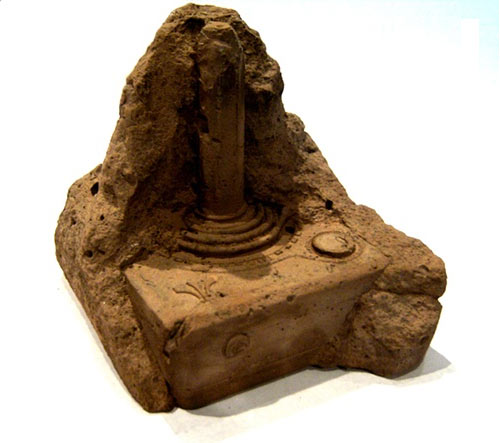
David Dobbs tells us about a new theory in genetics called the orchid hypothesis that suggests that the genes that underlie some of the most troubling human behaviors — violence, depression, anxiety — can, in combination with the right environment, also be responsible for our best behaviors.
Most of us have genes that make us as hardy as dandelions: able to take root and survive almost anywhere. A few of us, however, are more like the orchid: fragile and fickle, but capable of blooming spectacularly if given greenhouse care. So holds a provocative new theory of genetics, which asserts that the very genes that give us the most trouble as a species, causing behaviors that are self-destructive and antisocial, also underlie humankind’s phenomenal adaptability and evolutionary success. With a bad environment and poor parenting, orchid children can end up depressed, drug-addicted, or in jail — but with the right environment and good parenting, they can grow up to be society’s most creative, successful, and happy people.
From start to finish, this is one of the most interesting things I’ve read in weeks.
Old-school blogger Brad Graham was recently found dead at his home. More at MetaFilter, where a commenter says that he’d been ill for some time.
Pixar, social conservatives?
There is something conservative about much of Pixar’s output, but when I say conservative, I mean a small “c” conservative that sees the world along the same lines as Edmund Burke: “A disposition to preserve.” I’m going to call this “social conservatism,” by which I don’t mean the religious or moral conservatism of modern political discourse, but a conservatism that is interested in preserving traditional social features — in particular, the idea of “family” — but which sees such preservation as ultimately futile. The family will dissolve, eventually, and so we must do what we can to keep it going as long as possible. It is a worldview based not on progression but on loss.
This episode of This American Life about murder will put you in a weird mood. For instance, you might find yourself about to cry in the dairy aisle at the supermarket (not that such a thing happened to me, nosirreebob).
Act Two. The Good Son. - A story about a mother who wants to commit suicide and a son who dutifully helps her do it-even though his mother is a happy, healthy, independent person. How did they manage to pull it off? Practice, practice, practice.
Images from Paris cafes and nightlife in 1962, the same week Yves St. Laurent’s runway show vaulted Dior to new heights. Many scenes around Les Halles (which no longer exists as it did then).
From the collection, a photo of some Les Halles butchers enjoying a drink at Au Pied de Cochon:
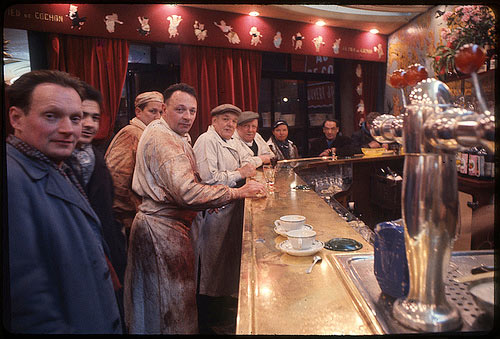
Update: As Wikipedia notes, Saint Laurent’s fabled show took place in 1958; Dior was gone from Dior by ‘62. Not sure whether the caption is wrong or the photos are really from 1958. (thx, alex)
A new book of conversations with Errol Morris done throughout his career. The tables have turned!
Maira Kalman takes on George Washington in the final installment of her excellent And the Pursuit of Happiness blog. The blog’s entries will be collected into a book due out in October 2010.
Useless superpowers orig. from Jan 15, 2009
Selling Wants to buy Haves orig. from Dec 16, 2009
* Q: Wha? A: These previously published entries have been updated with new information in the last 24 hours. You can find past updates here.
Amazing surfing video of Matt Meola orig. from Nov 04, 2009
Dogfighting vs. football in moral calculus orig. from Oct 12, 2009
Did Texas execute an innocent man? orig. from Sep 03, 2009
Missed connections, illustrated orig. from Sep 25, 2009
Watching them swim orig. from Jul 22, 2009
No one knows how to make a pencil orig. from Jul 09, 2009
Almost freezing to death orig. from Jun 04, 2009
The causes of increased healthcare spending in the US orig. from May 28, 2009
* Q: Wha? A: These previously published entries have been updated with new information in the last 24 hours. You can find past updates here.
Newer posts




Socials & More