Entries for April 2008
For scientist Dr. Anne Adams (and composer Maurice Ravel), a rare disease called frontotemporal dementia caused a burst of creativity.
The disease apparently altered circuits in their brains, changing the connections between the front and back parts and resulting in a torrent of creativity. “We used to think dementias hit the brain diffusely,” Dr. Miller said. “Nothing was anatomically specific. That is wrong. We now realize that when specific, dominant circuits are injured or disintegrate, they may release or disinhibit activity in other areas. In other words, if one part of the brain is compromised, another part can remodel and become stronger.”
Some of Adams’ work can be seen here…her portrait of pi contains a touch of synesthesia. (thx, cory)
Interview with young designer Nikolay Saveliev, who is responsible for this gorgeousness:
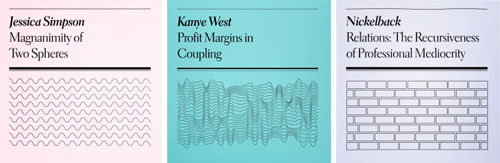
I like the idea of a consolidated aesthetic totality; what you make looks like what you listen to, sounds like what you wear, and speaks like what you believe in. In simpler terms, my girlfriend might look like she’s in a band I’d listen to, my haircut looks like it belongs in the chair I’m sitting in, and the work I’m designing might be written about in a book that I would read. Even my cat has to figure in there somehow. It’s a meticulous thing to maintain, but probably comes from the fact that I’ve discovered mostly everything through music, whether it’s ideologies, writers, artists, designers, cultures, subcultures, or other music. So it’s easy to tie things back into your work, as long as you keep your eyes and ears open, and maintain a healthy dose of critical thought.
“My haircut looks like it belongs in the chair I’m sitting in”. Awesome. (via quips)
A list of quintessentially New York books.
New York is a hypertextualized city. By 6 a.m., our commuters have smudged more words off their papers than most cities read all day. How to even begin identifying a canon? While reading, I plotted candidates along two mystical axes: one of all-around literary merit, and the other of “New Yorkitude” — the degree to which a book allows itself to obsess over the city. Robert Caro’s The Power Broker just about maxes out both axes; others perseverate so memorably on smaller aspects of city life that they had to be included.
The list includes Rem Koolhaas’ Delirious New York, Don DeLillo’s Great Jones Street, and Tom Wolfe’s The Bonfire of the Vanities.
New Improv Everywhere mission: make a local little league game feel like a major league game, complete with Jumbotron, play-by-play from NBC’s Jim Gray, and the Goodyear blimp.
The parents will be talking about this for a long time… the kids even longer. My son was a pitcher on the Lugnuts. We had a long/tough season last year. Saturday made up for everything. I want to sincerely thank you for making Saturday so unbelievable. It was like a birthday, Christmas, and New Years Eve captured in a few amazing hours. Thanks a million for a once in a lifetime opportunity.
A previous mission attempted to do the same thing with a small band but backfired.
Reporter Jorge Just brings us the story of Improv Everywhere, a group of New York City pranksters who found an unknown band from Vermont called Ghosts of Pasha and decided to give them “The Best Gig Ever.” They studied the band’s music and then crowded the club, pretending to be hard core fans. They thought of it as a kind of gift. But for the band, it was kind of a nightmare.
Sounds like this one went off a bit better. (via waxy)
Andy redesigned waxy.org.
For the first time since I started blogging in 2002, I’ve redesigned Waxy.org. Over the last six years, I’ve grown pretty sick of the old design but never found the time to rework it. Mostly, the changes are cosmetic. Cleaner design, new logo, bigger type, headlines, better iPhone support, and more space devoted to Waxy Links.
Looks nice.
According to a poll of 109 historians, George W. Bush is the Worst. President. Ever, hobnobbing with the likes of Millard Fillmore, James Buchanan, Andrew Johnson, and Franklin Pierce at the bottom of the barrel.
This marks a dramatic deterioration for Bush. Previously he wasn’t viewed in the most positive terms, but there was a consensus that he wasn’t the “worst of the worst” either. That was in the spring of 2004. In the meantime, Bush has established himself as the torture president, the basis for his invasion of Iraq has been exposed as a fraud, the Iraq War itself has gone disastrously, the nation’s network of alliances has faded, and the economy has gone into a tailspin-not to mention the bungled handling of relief for victims of hurricane Katrina. In 2004, only 12 percent of historians were ready to place Bush dead last.
That’s the most depressing paragraph I’ve read all day. And it doesn’t even address the Patriot Act and all the other civil liberties restrictions enacted with 9/11 as the excuse.
Flickr users can now upload video to their accounts. I uploaded a video during the beta test but since I’m not a pro user, I can’t show it to anyone now that Flickr’s gone public with the video uploading. :(
Update: Ok, Flickr Pro is back in effect. Still can’t mark the video unprivate. Maybe the video stuff isn’t truly live yet? (thx, heather & adam)
Update: Yep, the video stuff goes live “starting late Tuesday or early Wednesday”.
Update: The video stuff looks like it’s live now. Here’s a video of Ollie crawling that we took a couple of months ago. Videos are limited to 90 seconds…they’re calling them “long photos”. Love that.
I required redemption. When I arrived home two weeks ago after work, I was informed by my wife that I’d forgotten our anniversary. Eep. To partially make up for my cliched gaffe, I put my efforts towards getting a reservation at Momofuku Ko…the notoriously hard-to-get-into Momofuku Ko.1 We’re big fans of the other two Momofukus, so I logged into their online reservation system and happened to get something for last Friday night.
But this isn’t a story about their reservation system; too many of those have been written already. Bottom line: the food is wonderful and should be the focus of any Ko tale. Two dishes in particular were the equal of any I’ve had at other more expensive restaurants. The first was a pea soup with the most tender langoustine. The second dish, the superstar of the restaurant, was a coddled egg with caviar, onion soubise, and tiny potato chips (photo). Didn’t want that one to end. And I didn’t even mention the shaved foie gras (with Reisling built right in!) or the English muffins amuse or the nice wine pairings.
For the full food porn treatment, check out Kathryn’s photoset, a review at Goodies First, Ed Levine’s preview, Ruth Reichl’s first look, and a review by The Wandering Eater.
[1] Two quick notes on the reservation process.
1. I spent all of five minutes on a Saturday morning making the reservation on the Ko web site. It can be done.
2. Chang and co. are serious about the web site being the only way to get into the restaurant. As we were leaving after our meal, a friend of Chang’s and bona fide celebrity stopped in to say hi. After some chit chat, the fellow asked if he could get a reservation at Ko for the next evening. Chang laughed, apologized, and told him that he had to go through the web site. They’re not kidding around, folks. ↩
Graphical demonstration of the hand signals needed to buy and sell commodities on the floor of the New York Mercantile Exchange.
Video of the top 50 soccer goals. A dubbed-from-VCR YouTube video is probably not the best way to watch these, but that’s the hand we’ve been dealt.
My wife is a bit of a statistics nut. A few years ago, she hooked herself up to a heart rate monitor during a playoff football game and graphed the results. Sometimes I think she does things just so she’s got an excuse to open up Excel. So I wasn’t really surprised when she showed me this graph yesterday afternoon:
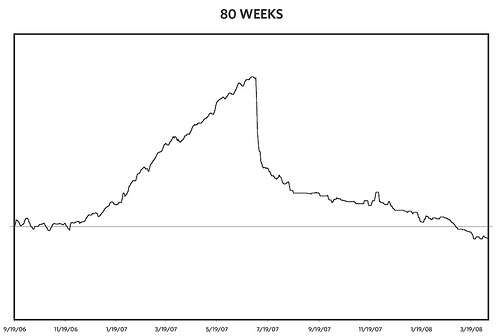
That’s a record of Meg’s weight from when she got pregnant with Ollie to the present, 80 weeks of data in all…40 weeks with Ollie on the inside and 40 on the outside.
Charles Joseph Minard may get all the accolades for his graphic of Napolean’s march to Moscow, but for me, the above chart is the most beautiful ever created. When I look at it, I see Ollie. The graph is a portrait of him, as sure as this photo is. It’s also a record of an intense time for our family. I’m reminded of Meg, happy and pregnant but also struggling with her changing body. Trips we took, doctor visits, the growing belly and anticipation, the birth itself, and then falling off the cliff into the giddy, difficult unknown of new parenthood. And then you can see Meg slowly but surely getting back into shape while being a full-time stay-at-home mom (and managing an architecture project to boot), and achieving her goal of getting back to her pre-baby fitness level in a scant 8 months. You can’t really see it, but there’s a happy father and proud husband in there somewhere as well.
That’s a lot of emotional impact for a simple black and white line graph with few labels. Imagine if it were in color and isometric 3-D! ;)
Everything I Know About Hyman Victor is one man’s remembrance of his great grandfather through old photographs and documents.
I feel like I’ve posted this one before but the Google says no so….LUNCH is a blog written by a couple of NYC architects who believe in the sanctity, sanity, and satiety of the lunch break.
We believe leaving the office everyday for lunch is an invaluable ritual. In a time and city where people are constantly rushing around, trying to accomplish three tasks at once, taking a moment to have a civilized meal becomes even more vital. Eating at your desk while reading emails, surfing the world wide web, snarfing down a bland turkey sandwich from the deli down the street is NOT lunch.
Each day they post photos of their lunches and afternoon snacks.
Ten ideas for making NYC streets a more friendly place for those not in automobiles, including the woonerf, bicycle boulevards, and the green grid.
A woonerf, which is surfaced with paving blocks to signal a pedestrian-priority zone, is, in effect, an outdoor living room, with furniture to encourage the social use of the street. Surprisingly, it results in drastically slower traffic, since the woonerf is a people-first zone and cars enter it more warily. “The idea is that people shall look each other in the eye and maneuver in respect of each other,” Mr. Gehl said.
Pedestrian, cyclists, and motorists looking each other in the eye reminded me of a passage that Tyler Cowen pulled from Peter Moskos’ Cop in the Hood:
Car patrol eliminated the neighborhood police officer. Police were pulled off neighborhood beats to fill cars. But motorized patrol — the cornerstone of urban policing — has no effect on crime rates, victimization, or public satisfaction. Lawrence Sherman was an early critic of telephone dispatch and motorized patrol, noted, “The rise of telephone dispatch transformed both the method and purpose of patrol. Instead of watching to prevent crime, motorized police patrol became a process of merely waiting to respond to crime.”
Officers traveling in high speeds in cars apart from pedestrian and living areas makes it difficult for them to look potential criminals in the eye. (thx, meg)
A chronological list of fears, from childhood through parenthood. (via lone gunman)
This is the ninth installment in an occasional series of updates to recent kottke.org posts. Previous installment is here, from almost a year ago. Eep.
Two still-active threads: will a helicopter on a treadmill take off? and my favorite kottke.org thread in recent memory, loads of people sharing words that they mispronounce on purpose.
Ben Saunders had to break off his attempt at a speed record to the North Pole after only eight days because of an equipment failure. The bolts on his skis snapped.
Those few hours in the tent were some of the lowest of my life; I thought of all the people that had gone so far out of their way to make this expedition happen, of the weeks of intense preparation, the months of training and the years of experience, testing and perfecting everything from my diet to the design of the sledge. This expedition was the physical embodiment of one of the biggest and most audacious dreams I’ve ever had, and the whole thing hung from a giant chain that involved countless people, places, promises and pieces of equipment. It turned out on Friday morning that the weakest link of that entire chain was a pair of screws, each with a head the size of my little finger tip, and each snapped clean in half.
Speaking of the cold north, I lamented the lack of charts in this post about the earlier onset of spring thaw in the northern hemisphere. Erin whipped one up for us.
Related to these architectural offices in an old auto body shop are the offices of a small London start-up operating out of a carriage from the London Tube.
You want strange restaurant names? I give you, The Butt and Oyster. (thx, nick)
The lost Prada sunglasses have not been found by their owner.
More abandoned amusement park photos: Maryland’s Enchanted Forest and Seoul’s Dreamland. (thx, guy & ross)
The business of parenting was a popular post…maybe I should turn kottke.org into a dad blog? Well, until that happens, here’s a couple of related items that people sent in. First up is an NPR story on teaching kids how to play. Part of the solution discussed in the story? Deliberate practice. It’s all connected, isn’t it? And here’s an earlier related story. (thx, michael & matt)
Here’s a tangential connection: reading magazines within a Google Maps interface is related to telling stories using maps. And of course, there’s Microsoft’s Seadragon technology, demoed briefly at the start of this TED presentation. (thx, barrett)
Back in January, I linked to an interview of a hedge fund manager at n+1. They’ve posted a second interview with the same manager and he discusses, among other things, what happened with that whole Bearn Sterns run-outta-money government bailout thing.
More on the periodic table. Periodically is an album put together by DBLF Studios featuring 119 songs, one for each element. Peep the lyrics; here’s a bit of the lithium tune:
I’m unbelievable for non-linear optics
high performance jet helicpotics
I have numerous commercial applications
am no longer integral for atomic weapons
unfortunately meth-amphetamines I do catalyze
I absorb carbon dioxide when I hydroxize
nuclear fusion totally relies on me
I allow the criminally insane to go running free
There is also Tom Lehrer’s The Elements, a recitation of the elements of the periodic table, sung to the tune of Gilbert and Sullivan’s Major-General’s Song. Of course you can hear it on YouTube. (thx, george & philip)
A pair of responses to Rent Vs. Buy Myths That Ruined the Housing Market: Myths, Media, Motives: A Cautionary Tale and The Nonsense of “Rent Vs. Buy Myths That Ruined the Housing Market”.
MovieStamer has filled out a bit more.
Some popular tags from the last three weeks: standardoperatingprocedure, movies, photography, lists, design, books, abughraib, video, food, science, errolmorris, interviews, war, bestof, nyc, videogames, games, typography, www, tv, art, sports, sex, architecture, and religion.
Photographer Eric Etheridge alerted me to a new series he recently started on his WordBlog called Photography: The Missing Criticism, “which aims to bring great writing on photography back into print”. The series currently consists of a 1981 essay by Tod Papageorge on Walker Evans and Robert Frank and a 2002 essay by Papageorge on Robert Adams.
Crayon Physics is PC-only so I can’t play it, but Magic Pen will do in a pinch. Don’t start playing unless you’ve got a few hours to spare. (via waxy)
Some poop in a cave in Oregon has been dated to more than 14,000 years ago and identified as human, adding to other evidence that humans inhabited the Americas before the well-known Clovis people.
Other archaeologists agreed that the findings established more firmly than before the presence of people on the continent at least 1,000 years before the well-known Clovis people, previously thought to be the first Americans. Recent research at sites in Florida and Wisconsin also appears to support the earlier arrivals, and a campsite in Chile indicates migration deep into South America by 14,600 years ago.
The airplane on a conveyor belt question was just recently settled and we’re confronted with a related question: will a helicopter on a turntable take off? The image is short on details and likely a joke, but let’s assume that the turntable will match the speed of the helicopter’s rotor (and further that the rotor’s speed is measured relative to the helicopter and the turntable’s speed is relative to the ground, otherwise it doesn’t make much sense). Will the helicopter take off? Does it matter which way the turntable is spinning relative to the rotor? (thx, daniel)
Gorgeous maps and infographics by Stefanie Posavec that map the literary geography of Jack Kerouac’s On the Road.
The maps visually represent the rhythm and structure of Kerouac’s literary space, creating works that are not only gorgeous from the point of view of graphic design, but also exhibit scientific rigor and precision in their formulation: meticulous scouring the surface of the text, highlighting and noting sentence length, prosody and themes, Posavec’s approach to the text is not unlike that of a surveyor. And similarly, the act is near reverential in its approach and the results are stunning graphical displays of the nature of the subject. The literary organism, rhythm textures and sentence drawings are truly gorgeous pieces.
The sentence drawings are really worth checking out.
Update: Posavec’s analysis of Walter Benjamin’s The Work of Art in the Age of Mechanical Reproduction is available for sale at 20x200. Apropos!
Great set of photographs showing how the Space Shuttle gets ready for takeoff, from the Vehicle Assembly Building all the way to the launch pad.
How to catch a thief…of Netflix DVDs:
After having to file multiple Netflix movies as “lost in the mail” I began to get suspicious that there was more than just a careless mailman at fault. So what better to do than point a video camera at the mailbox and try to catch a Netflix thief.
…of cars:
An internet posse of Canadian gearheads used an online forum, Facebook and Google Maps to take down what might be the world’s dumbest car thief — and posted video of the arrest on YouTube.
…of saddles:
A week after dozens of people ransacked an Oregon home in response to a Craigslist ad offering its contents for free, police have arrested a couple for orchestrating the online hoax as part of a bid to cover up an earlier burglary at the property. Brandon and Amber Herbert were nabbed last night for allegedly posting the March 22 Craigslist ad, which claimed that the Jacksonville ranch’s owner had to leave town so suddenly that his belongings — which included a horse — were available for the taking.
The new Coen Brothers film sounds interesting:
Burn After Reading is an upcoming comedy film, set for a September 12, 2008 release, starring John Malkovich, George Clooney, Tilda Swinton, Frances McDormand and Brad Pitt, and made by Joel and Ethan Coen. According to the Coens the plot will focus on the world of the CIA, physical fitness in Washington, D.C., and internet dating. The film is the follow up to the Academy Award winning No Country For Old Men and has been described by Tilda Swinton as “…a kind of monster caper movie. All of us are monsters — like, true monsters. It’s ridiculous. It’s much lighter than ‘No Country for Old Men.’”
A list of 63 must-have grunge fonts. Back in 1996, this would have been my thing. Is grunge type coming back?
Preliminary results from a small Swedish study suggest that effects of steroid use stay with you even after stopping.
Rather than returning to their original proportions, the muscles of the steroid users who’d stopped taking the drug looked remarkably similar to those of the subjects who were still using. They also had larger muscle fibers and more growth-inducing “myonuclei” in their muscle cells than the nonsteroid users.
Just got around to reading Ben McGrath’s New Yorker profile of Lenny Dykstra, the former baseball All-Star who has, somewhat improbably, become rich post-baseball as a business owner and day trader.
Dykstra last played in the majors in 1996, at age thirty-three. Improbably, he has since become a successful day trader, and he let me know that he owns both a Maybach (“the best car”) and a Gulfstream (“the best jet”).
But maybe not so improbably…Dykstra has a canny sense for business:
Dykstra chose car washes, he says, because of the automobile-centric culture in California, and because “it was a business that couldn’t be replaced by a computer chip.” He brought his own frustrated consumer experiences to bear in creating the business model, and eliminated many of the usual array of motor-oil choices-startup, high-mileage, various blends-from his inventory. “You get the shit out of the ground,” he said, referring to standard Castrol GTX, “or the shit made in the laboratory that’s the perfect lubricant” (Syntec). “Meaning, it’s either A or B. It’s not about the oil. It’s about the people. They got confused.” He stocked the places with baseball memorabilia and flat-screen TVs, and served free coffee (“the good kind”), so that customers would associate the experience with luxury rather than with cumbersome chores.
One of the characteristics of Dykstra the businessman is his constant use of baseball metaphors and comparisons. Here’s a listing from the article:
The Players Club, in contrast to the television installation, would be “major league,” he explained, and to that end he was assembling an editorial staff of “.300 hitters,” and lining up sponsors to match.
Dykstra’s business card gives an address for the “headquarters” of The Players Club, at 245 Park Avenue, which he describes as “big league-like, top five addresses in the world.”
Next, he took a call from a designer he wanted to hire for the magazine. “You worked for Esquire and In Style,” he said, delivering a pep talk. “That’s called the big leagues. It’s like in baseball. You can’t go above the major leagues. There’s not another league. We’re teeing it up high, dude.”
He quoted from Confucius, Dickens, and Billy Joel, and balanced straight stock picks (“Intel is the N.Y. Yankees of the chipmakers”) with musings about fatherhood and current events, like the war in Iraq, seldom passing up the opportunity to draw extended sports analogies.
“My approach in investing is much the same as my approach to hitting,” he wrote. “I would rather take a walk or single and reach first than shoot for a home run and strike out swinging.”
Dykstra hopes the magazine will help players recognize the importance of marriage and family. He drew three stick figures and named them Tom, Dick, and Harry. Above Tom, he drew a man and a woman-two parents. Dick got a father but no mother, and Harry the reverse. “Do you know the studies and what they’ve proven?” he asked. “You should look that up, dude. Like, bad things. It’s like the one-one count.” The one-one count is another of Dykstra’s baseball metaphors for life, meant to illustrate that some moments, and the choices they bring, are more fateful than others (i.e., the next pitch makes all the difference), or, in this case, that circumstances set in motion during the early stages of development are difficult to overcome later on. If a batter falls behind, one ball and two strikes, he’s in a hole from which, the statistics augur, he will not recover, even if he is Barry Bonds; and if he gets ahead, to two balls and one strike, he wrests control from the pitcher and takes charge of his own destiny. Having two parents puts you in control of life’s count, and enables you to become a .300 hitter.
Here’s an archive of Dykstra’s articles on trading for The Street.
Update: Not so fast, Nails. Seems as though Mr. Dykstra’s business sense was not that good; he recently filed for chapter 11 bankruptcy.
The 46-year-old has no more than $50,000 of assets and between $10 million and $50 million of liabilities, according to a petition filed Tuesday with the U.S. Bankruptcy Court in the Central District of California.
Dykstra’s filing comes in the wake of more than 20 lawsuits he faces tied to his activities as a financial entrepreneur, including The Players Club, a glossy magazine for athletes he had helped launch in 2008.
Sounds like he was a little over-leveraged. (thx, todd)
Errol Morris returns to his Times blog for the first time since his examination of the Roger Fenton photographs and covers re-enactments in documentary films, a technique he pioneered in the excellent The Thin Blue Line, and how it applies to truth in photography.
Critics argue that the use of re-enactments suggest a callous disregard on the part of a filmmaker for what is true. I don’t agree. Some re-enactments serve the truth, others subvert it. There is no mode of expression, no technique of production that will instantly produce truth or falsehood. There is no veritas lens — no lens that provides a “truthful” picture of events. There is cinema verite and kino pravda but no cinematic truth.
And then:
Is the problem that we have an unfettered capacity for credulity, for false belief, and hence, we feel the need to protect ourselves from ourselves? If seeing is believing, then we better be damn careful about what we show people, including ourselves — because, regardless of what it is — we are likely to uncritically believe it.
Review of Clerks, 14 years after it was released. Verdict: it doesn’t hold up that well.
I don’t think I laughed more than a couple of times. And for the past 14 years, all I could remember about the film was the pick-up hockey game on the roof and the big punchline about Dante’s ex-girlfriend’s encounter in the bathroom. In the years that have followed, the cult of Kevin Smith has waxed and waned but mostly endured, spinning off into comic books, diaries, and concert appearances, several well-trafficked websites (and many other fan sites), and other assorted merchandise and pop-cultural flotsam.
I’ve never understood why Clerks was so well-regarded. Actually, now that I think about it, despite an affection for Mallrats shared by almost no one with any sense, I don’t like any of Smith’s movies but I do like Smith and the way that he goes about making his films…if that makes any sense at all. (Ok, Chasing Amy was alright and Jersey Girl was underrated.)
Frank Bruni, the food critic for the NY Times, wrote yesterday about the difficulty of getting a reservation at David Chang’s new Momofuku Ko restaurant. Ko’s online reservation system is the *only* way of procuring a seat at the tiny Manhattan restaurant…no walk-ins, no friends of the chef or celebs getting preferential treatment. It works more or less like Ticketmaster’s online ticketing: you select the number of guests, it shows you the available reservation times (if any), you click on a time, and if that time is still available when you click it, only then does the system hold your choice while you fill in some information.
It’s a simple system; seats for dinner are released on the site a week in advance at 10am each day and the people that click on their preferred times first get the reservations. Ko takes only 32 reservations each night and the restaurant is one of the hottest in town, which means that all the reservations are gone each day in seconds…sometimes in 2 or 3 seconds. Just like Radiohead tickets on Ticketmaster.
Except that diners are not used to this sort of thing. One of Bruni’s readers got irritated that he got through to the pick-a-time screen but then when he clicked on his preferred time was told that the reservation was already gone. Someone had beaten him to the punch. So he emailed the restaurant for an explanation. The exchange between the restaurant and the snubbed patron should be familiar with anyone who has done web development for clients or any kind of tech support.
In a nutshell, the would-be patron said (and I’m paraphrasing here), “your system is unfair and broken,” and the folks at Ko replied, “sorry, that’s how the internet works”. The comments on the post are both fascinating and disappointing, with many people attempting to debunk Ko’s seemingly lame excuse of, well, that’s how the internet works. Except that’s pretty much the right answer…although it’s clearer to say that that’s how a web server communicates with a web browser (and even that is a bit imprecise). When the pick-a-time page is downloaded by a particular browser, it’s based on the information the web server had when it sent the page out. The page sits unchanged on your computer — it doesn’t know anything about how many reservations the web server has left to dole out — until the person clicks on a time. An anonymous commenter in Bruni’s thread nails the choice that a web developer has to face in this instance:
This is a multi-user concurrency problem that all sites with limited inventory and a high demand (users all clicking the button all at the same time) have to deal with. It’s not an easy problem to solve.
The easier method (which the Ko site has chosen) is to not “lock” a reservation slot until the very end. You submit your party size and the system looks for available slots that it knows about. It shows you the calendar page, with the available slots it knows about (if any). This doesn’t update in real time because they haven’t implemented it to know about the current state of inventory. This can be done, but it’s more complicated.
The more complicated method is to lock a reservation slot upon beginning of the checkout process, with a time out occurring if the user takes too long to finish, or some other error occurs (in other systems this can be a blacklisted credit card number). If this happens, the system throws the reservation slot back into the pool. However, you need to give people a mechanism to keep trying for ones that get thrown back into the pool (like a “Try Again” button).
Building something like this not impossible (see Ticketmaster) but requires a much more real-time system that is aware of who has what, and what stage of the checkout process they’re in - in addition to total available inventory. Building a robust system like this is not cheap.
Even then, you might get shut out. You submit your party size, everything is already gone, and you never get to the calendar page. It just moves up the “sold out” disappointment to earlier in the process.
A subsequent commenter suggests using “Web 2.0” technologies (I think he’s talking specifically about Ajax) but as Anonymous suggests, that would increase the complexity of the system on the server side (unnecessarily in my mind) while moving up the “‘sold out’ disappointment to earlier in the process”. Plus, that sort of system could put you “on hold” for several minutes while the reservations are taken by the folks in front of you until you’re told, “too bad, all gone”. I’m not sure that’s preferable to being told sooner and may result in much more irritation on the part of potential diners.
In my opinion (as a web developer and as someone who has used Ko’s reservation system from start to finish), Ko’s system does it right. You’re locked into a reservation by the system only when you’ve chosen exactly what you want. It favors the web user who’s prepared & lucky and is simple for Ko to implement and maintain. That the logic used to produce this simple system takes three paragraphs to explain to an end user is irrelevent. After all, a restaurant dinner is easy to eat but explaining how it came to be that way fills entire books.
This might seem too inside baseball for most readers — the number of people interested in new NYC restaurants *and* web development is likely quite small, even among kottke.org’s readership — but there’s an interesting conflict going on here between technology and customer service. What kind of a problem is this…technological or social? Bruni’s correspondent blamed the technology and much of the focus of the discussion has been on the process of procuring a reservation. But the main limiting factor is the enormous demand for seats; tens of thousands of people a week vying for a few hundred seats per week. The technology is largely irrelevent; whatever Ko does, however well the reservation system works or doesn’t work, nearly all of the people interacting with the restaurant are going to be disappointed that they didn’t get in.
Recent research suggests that:
There is no clear evidence of benefit from drinking increased amounts of water.
In particular, scientists found no evidence that the common recommendation of eight 8-oz glasses of water per day has any benefit. NPR busts some additional water myths.
The bracket for Market Madness (aka the Fed 2008 Final Four Rate Cuts) pairs the biggest banks in the world against each other. Who’ll be bailed out next? See also: Bracket Madness.
Short interview with bassist Colin Greenwood about the State of Radiohead, among other things.
Pitchfork: The Pitchfork review of Hail to the Thief put forth the idea that “anything Radiohead does from here on out will sound like Radiohead”…
CG: That’s like a late-night stoner comment. At about three in the morning — after you’ve put on Captain Beefheart and you put the red scarf over the light bulb — it makes a lot of sense. But the next morning you’re like, “I don’t know, maybe the world is fucked and we didn’t solve it.” So I don’t know about that.
Sounds like he’s got Pitchfork figured out. And as your musical sommelier, I’d recommend the 2007 In Rainbows with this interview.
Kevin Kelly says that people whose fields have been Turing’d — outsourced in some way to computers — are in general more receptive to then adopting other potentially disruptive technologies.
We have this long list of tasks and occupations that we humans believe only humans can do. Used to be things like using tools, language, painting, playing chess. Now, one by one they get Turing’d. A computer beats them. Does it better.
So far we’ve can check off arithmetic, spelling, flying planes, playing chess, wiring chips, scheduling tasks, welding, etc. All have been Turing’d.
Computer scientists are great to work with, because in general they are completely fearless. They were Turing’d long ago. They grok that many of the tasks they used to do can be done much better by computers. On the other hand, doctors as a rule are loathed to accept new technology because what they do is hard to delegate to computers. Ditto for a lot of biologists.
People have a limited supply of willpower.
The brain has a limited capacity for self-regulation, so exerting willpower in one area often leads to backsliding in others. The good news, however, is that practice increases willpower capacity, so that in the long run, buying less now may improve our ability to achieve future goals — like losing those 10 pounds we gained when we weren’t out shopping.
This explains *so much*.
Fun little article by Grant Barrett about people saying words wrong on purpose.
I sometimes say “muscles” so that the ‘c’ has a ‘k’ sound (the same way the cartoon character Popeye says it), computor instead of “computer” (after Ned Beatty’s exaggerated pronunciation of “Mr Luthor” in the Superman movies), and I occasionally say benimber instead of “remember” because it was something my cousin Paul said more than 20 years ago.
I use several of these mispronunciations regularly, which drives Meg nuts. Nucular, saxamaphone, muscles with Popeye’s hard c, computor, robit for robot, etc. Those of you who speak other languages…is this a common behavior outside of English?
Update: Language Log found a 1932 article about Intentional Mispronunciations. From a summary of the article:
Her categories include everything from adding or subtracting syllables and restressing (antique as “an-tee-cue”, “champeen”, “the-‘ater”), tensing lax vowels (“genu-wine”), borrowing of “vulgar” pronunciations (“agin”, “extry”, “who’d-a thunk it”, “varmint”)…
Bruce Bukiet is back with his annual mathematically modeled prediction of how the upcoming baseball season is going to play out. His results should be taken with a grain of salt; last year he picked the Yankees to win 110 games (they only won 94).
Speaking of the Yankees, Derek Jeter always seems to get a lot of credit for those four World Series victories in five years but a quick look at the OBP stats for those years shows that Bernie Williams was the engine driving that offense. Jeter’s a little overrated maybe?
Jonathan Hoefler on how a joke version of OCR-A with swashes came about…and then ended up in an issue of Rolling Stone.
I tacked this specimen of Estupido Espezial!!! to my wall, where it immediately became a litmus test for visitors. Most people would say nothing, but woe be unto anyone who admired the thing in earnest: “hey, cool font!” would immediately land any visitor on the Suspicious Persons list. The best were those who would stare for a moment with bafflement before bursting out laughing, a few of whom became good friends, good clients, or both.
Robots need type too.
A large list of interesting print catalogs for niche industries and hobbies.
Cabela’s. 1400 pages of hunting, fishing & outdoor gear. Comes with foldout index tabs and if you spend appalling amounts there (like my SO), they send you a hardbound version.
(via mathowie)
I did embarrassingly bad on this Elements of the Periodic Table quiz. I blanked after naming 17 elements in 2 minutes. Oh, and xylophone is not an element! My physics degree should be retroactively unawarded. (via mouser)
Slowing down the playback of a 1999 Apple commercial = drunk Jeff Goldblum. “Internet? I’d say Internet.” Great stuff, indeed. (via cynical-c)
Roger Ebert announces his return to his Sun-Times reviewing gig…but not his TV show because he’s currently unable to speak.
Are you as bored with my health as I am? I underwent a third surgery in January, this one in Houston, and once again there were complications. I am sorry to say that my ability to speak was not restored. That would require another surgery. But I still have all my other abilities, including the love of viewing movies and writing about them.
Good luck, Roger!
The new design for UK coinage is fantastic.
As you can see in the image to the right, the Shield of the Royal Arms has been given a contemporary treatment and its whole has been cleverly split among all six denominations from the 1p to the 50p, with the £1 coin displaying the heraldic element in its entirety. This is the first time that a single design has been used across a range of United Kingdom coins.
This is my favorite bit of design so far this year. (via we made this)
Update: Jonathan Hoefler compares the new UK coins, designed by a first-time currency designer, to the new US five dollar bill.
Below, the new five dollar bill, introduced last month by the United States Department of the Treasury. The new design, which features a big purple Helvetica five, is the work of a 147-year-old government agency called the United States Bureau of Engraving and Printing. It employs 2,500 people, and has an annual budget of $525,000,000.
It looks like Purple Modernistan is invading the US from the southeast.
A golden oldie from Matt Jones in 2001: WebDogme.
Two Danish filmmakers, Lars von Trier and Thomas Vinterberg in 1995 responded to what they saw as the increasing inhumanity and formulaic commerciality of effects-heavy, franchise-friendly feature films. They created a vow of chastity that placed the stylistic presentation and formal tricks of film subservient to the narrative and characterisation.
WebDogme is an attempt to outline a similar approach for the web. kottke.org is doing pretty well on the rules…I’ve unwittingly followed 5 or 6 of them at least. I’d link to the original Dogme 95 manifesto, but the official web site does not adhere to WebDogme rule #3 (“The browser must not be violated”); the manifesto is hidden within a frame. (via preoccupations)
Ooh, there’s going to be a Dr. Mario game available for the Wii at some point, playable over the network. It’s already downloadable via WiiWare in Japan…which should not be confused with the Virtual Console downloadable games even though the difference is really confusing.
A review of Outside (i.e. the outside world) as if it were a video game.
In terms of the social environment, almost anything goes. Outside has a vast network of guilds, many of its players are active participants in designing the game’s social environment, and almost any player will be able to find company to undertake their desired group quests. On the other hand, gold-buying is rife, the outskirts of virtually every city zone in the game are completely overrun by farmers, and the developers have so far proven themselves reluctant to answer petitions, intervene in inter-player disputes, or nerf broken skills and abilities. Indeed this reviewer will go so far as to say that the developers are absent from the game entirely, and have left it to its own devices. Fortunately, server uptime has been 100% from day 1, despite there being only one server for literally billions of players.
The reviewer gives it a 7/10.
Newer posts
Older posts








Socials & More