Entries for March 2008
Here’s a novel interview technique: AJ Jacobs sits George Clooney down in front of a computer and talks about what the internet says about him.
We are logged on to a Facebook group called “George Clooney is NOT the sexiest man alive.”
“Ninety-four members,” says Clooney as he looks at the photo of himself with a red X through it. “What the fuck?”
He reads the site’s manifesto aloud:
I for one am sick and tired of George Clooney thinking hes the sexiest man alive, like jesus hes so old! It’s just not right. That man is so full of himself it isn’t funny. Join this group if you totally agree with me.
“Should I defend myself in this one?”
Clooney dictates and I type:
That’s bullshit. He looks great for a 70-year-old.
The Novelists Guild of America strike is having no discernible impact on the nation.
“We must, as a people, achieve a resolution to this strike soon,” novelist David Foster Wallace said at a rally Monday at Pomona College in Claremont, CA, where he is a professor. “The thought of this country being deprived of its only source of book-length fiction is enough to give one the howling fantods.”
“I thank you both for coming,” he added.
Powerful and disturbing article by Philip Gourevitch and Errol Morris from this week’s New Yorker about the photographs taken at Abu Ghraib.
Later, when the photographs of crimes committed against Iraqi prisoners at Abu Ghraib were made public, the blame focussed overwhelmingly on the Military Police officers who were assigned to guard duty in the Military Intelligence cellblock — Tiers 1A and 1B — of the hard site. The low-ranking reservist soldiers who took and appeared in the infamous images were singled out for opprobrium and punishment; they were represented, in government reports, in the press, and before courts-martial, as rogues who acted out of depravity. Yet the abuse of prisoners at Abu Ghraib was de facto United States policy. The authorization of torture and the decriminalization of cruel, inhuman, and degrading treatment of captives in wartime have been among the defining legacies of the current Administration; and the rules of interrogation that produced the abuses documented on the M.I. block in the fall of 2003 were the direct expression of the hostility toward international law and military doctrine that was found in the White House, the Vice-President’s office, and at the highest levels of the Justice and Defense Departments.
Never mind liberty, it would seem that we’re giving up our humanity for security.
Update: Nuts, they took the article offline for some reason…
Update: Looks like the article is back up. For now.
This talk by neuroanatomist Jill Bolte Taylor was universally considered the best talk at the TED conference last month. In it, she describes the lessons she learned from studying her stroke from inside her own head as it was happening.
And in that moment my right arm went totally paralyzed by my side. And I realized, “Oh my gosh! I’m having a stroke! I’m having a stroke!” And the next thing my brain says to me is, “Wow! This is so cool. This is so cool. How many brain scientists have the opportunity to study their own brain from the inside out?”
New trailer for Speed Racer…watch it in full HD glory if your internet connection can take it. The courses remind me even more of Mario Kart than in the first trailer.
We’ve heard from the sex workers about the Spitzer affair. Now the psychologists. This article compiles many ideas about why Spitzer did what he did:
Psychologist Christopher Ryan, author of “Sex in Prehistory,” says the desire for sex with more than one person has always been there — for leaders and followers alike. “The desire is not a function of status or power — it’s a question of availability.”
What’s relatively new to the human race, he said, is the ability to exercise power and the connection between power and sex.
That’s because, for most of human existence, there was only so far a man could coerce others when food was essentially free and hard to hoard. And until relatively recently, sex with multiple partners was the norm. “It would have been very unusual 100,000 years ago for a person to have one sexual partner for 30 years,” said Ryan in an interview from Barcelona.
And here’s the evolutionary psychological point of view:
She points out that, while powerful men throughout western history have married monogamously (they had only one legal wife at a time), they have always mated polygynously (they had lovers, concubines, and female slaves). Many had harems, consisting of hundreds and even thousands of virgins. With their wives, they produced legitimate heirs; with the others, they produced bastards (Betzig’s term). Genes and inclusive fitness make no distinction between the two categories of children. While the legitimate heirs, unlike the bastards, inherited their fathers’ power and status and often went on to have their own harems, powerful men sometimes invested in their bastards as well.
As a result, powerful men of high status throughout human history attained very high reproductive success, leaving a large number of offspring (legitimate or otherwise), while countless poor men in the countryside died mateless and childless.
(thx, anne)
Update: And one more from Natalie Angier:
Yet as biologists have discovered through the application of DNA paternity tests to the offspring of these bonded pairs, social monogamy is very rarely accompanied by sexual, or genetic, monogamy. Assay the kids in a given brood, whether of birds, voles, lesser apes, foxes or any other pair-bonding species, and anywhere from 10 to 70 percent will prove to have been sired by somebody other than the resident male.
Three cities, two serious relationships, one child, 200,000 frequent flier miles, at least seven jobs, 14,500 posts, six designs, and ten years ago, I started “writing things down” and never stopped. That makes kottke.org one of a handful of the longest continually updated weblogs on the web…something to be proud of, I guess. The only thing I’ve done longer than kottke.org is sported this haircut. (Perhaps not something to be proud of…the hair-in-stasis, I mean.)
Being a digital packrat, I have screenshots of all the past designs the site has had. When I started, the posts were actually hosted on another site of mine, 0sil8, that I’d been doing since 1996. I didn’t know at the time that kottke.org would eventually kill 0sil8. This was the first design (full size):

It’s a little misleading because there’s only one post shown on the page…there were usually more, displayed reverse chronologically. The stars were a rough rating of how well that day had gone called the fun meter.
When I moved the site to its own domain after a few months, I redesigned it to look like this (full size):
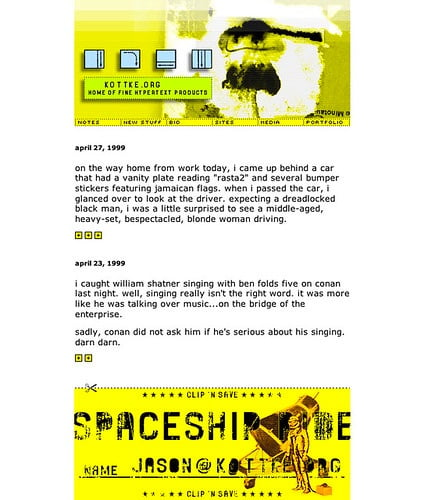
The aesthetic was influenced by the pixel grunge style of Finnish designer Miika Saksi…you can see some of his older work here. The font in the navigation is Mini 7…Silkscreen was still several months away at that point. The fun meter is still present as is the all-lowercase text, a house style I thankfully dropped a few months later. The cringeworthy writing took a few more years to iron out…if it ever fully was.
This one’s still my favorite; it turned a lot of heads back in the day (full size):

With dozens of spacer gifs and five concentric tables, it was a bitch to code. There was also a capability to modify the look and feel of the site…you could choose between this design, the older design pictured above, and a text-only version. Inline permalinks were introduced on kottke.org in March 2000 and subsequently the idea was spread across the web by Blogger.
But it only lasted for about a year. In late 2000, I swapped it for this one (full size):

The familiar burn-your-eyes-out yellow-green makes its first appearance. I never really meant to keep it or for it to become the strongest part of the site’s identity. After this design launched, I cycled through a few colors (the old yellow, blue, red) before getting to the yellow-green…and then I just got lazy and left it. For 8 years and counting. The post style underwent several changes with this design. In June 2002, I switched to Movable Type after updating the site by hand for four years. Soon after that, I added titles to my posts. In late 2002, I added a frequently updated list of remaindered links to the sidebar. In late 2003, the remainders moved into the main column and have become an integral part of the site. I also started reviewing movies and books around this time…kottke.org became a bit of a tumblelog.
In July 2004, I refreshed the design a bit…tightened it up (full size):
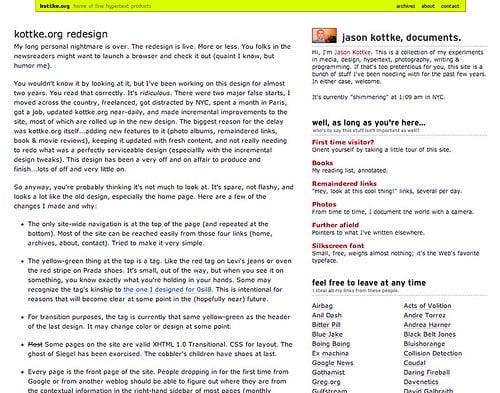
After about a year, I changed it again to the current look and feel (full size):
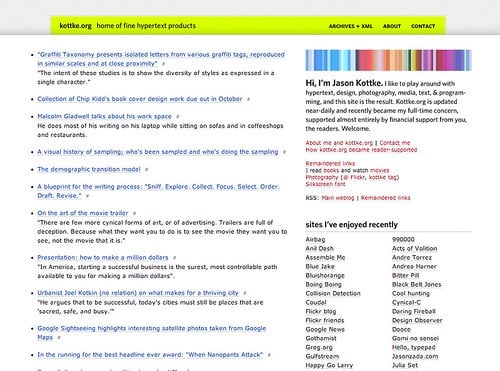
Sorry, that got a little long…there’s a lot I didn’t remember until I started writing. Anyway, I didn’t intend for this to become a design retrospective. Mostly I wanted to thank you very sincerely for reading kottke.org. Over the last ten years, I’ve poured a lot more of myself than I’d like to admit into this site and it’s nice to know that someone out there is paying attention. [Cripes, I’m choking up here. Seriously!] Thanks, and I’ll see you in 2018.
Due to “when will the ice break up” contests in Alaska and other records dating back more than 150 years, climate scientists are able to study the onset of spring thaws.
Seventeen lakes in Europe, Asia and the U.S. with records going back 150 years are thawing, on average, 13 days earlier now than when first recorded, said Wisconsin lake scientist Barbara Benson.
Frustrating that there’s no charts associated with the story; this is a case where a picture would be worth 1000 words.
Forgotten Architects.
Nearly 500 Jewish architects were working in Germany before 1933; today the fate of most of them is unknown. Following is a look at 43 of these architects whose groundbreaking work is sadly forgotten.
Here’s some context about the project.
Google Sky is like Google Earth for the, er, sky. The historical constellation drawing overlay is very cool.
P.S. I starting sobbing like a little baby when I saw this.
Only three men have ever graced the cover of American Vogue. LeBron James is on the cover this month with Gisele Bundchen…see if you can guess the other two before you click through.
Chef Dan Barber, proprietor of NYC’s Blue Hill, is planning on writing a book or two. I still fondly remember Barber’s Food Without Fear op-ed in the NY Times in 2004.
One of the side effects of the Eliot Spitzer situation is the discussion of prostitution happening in various places online by those with experience in or knowledge of that profession. Here are a few I’ve run across.
On the Freakonomics blog, an interview with a “high-end call girl” named Allie about the Spitzer affair.
Almost all of my clients are married. I would say easily over 90 percent. I’m not trying to justify this business, but these are men looking for companionship. They are generally not men that couldn’t have an affair [if they wanted to], but men who want this tryst with no stings attached. They’re men who want to keep their lives at home intact.
Susannah Breslin talks about her twin web projects, Letters from Johns and Letters from Working Girls and what light they could shed on Spitzer’s actions.
But one high-end call girl I spoke to about the Spitzer affair said there are lots of reasons a man in such a prominent position might seek high-stakes sex with a prostitute. Why not just have an affair, which probably wouldn’t have destroyed his career? She said that Spitzer, if he did use prostitutes, was probably one of those men for whom the payoff was the excitement of doing something really taboo. “What could be more taboo than going to an agency when you’re a crusader for all that is moral and good?” she theorized. “It’s only natural,” this call girl asserted, “that they’d hire a girl to get off.” She speculates that there was probably a “midlife crisis element” there too.
Former Hollywood madam Heidi Fleiss chimes in:
Look, it’s going to go on. You’re never going to stop prostitution. The way to do it is to regulate it. Clean it up a bit. Make it fair-fair for the girls, fair for the clients. At the end the government gets money out of it.
A Former Sex Worker’s Thoughts About Eliot Spitzer.
I’m a former sex worker. I still have many sex worker friends that are dear to me. Ones who both face all the risks of being a sex worker, but also fight for sex worker rights in public. They are at risk from the very policies of men like Spitzer. Eliot could have done something groundbreaking. He could have been a governor that dared to advocate for sex worker human rights. But he didn’t. Eliot persecuted sex workers. He made it easier for sex workers to be exploited, to be violated, to be stigmatized, to face discrimination, to face rape, assault and other crimes.
Sociologist Sudhir Venkatesh has done research on high-end sex workers in NYC and elsewhere. He explains how it works in this Slate article.
What high-end clients pay for may surprise you. For example, according to my ongoing interviews of several hundred sex workers, approximately 40 percent of trades in New York’s sex economy fail to include a physical act beyond light petting or kissing. No intercourse, no oral stimulation, etc. That’s one helluva conversation. But it’s what many clients want. Flush with cash, these elite men routinely turn their prostitute into a second partner or spouse. Over the course of a year, they will sometimes persuade the woman to take on a new identity, replete with a fake name, a fake job, a fake life history, and so on. They may want to have sex or they may simply want to be treated like King for a Day.
If you run across any similar links, send them along.
A post by Jonah Lehrer about thinking under pressure links deliberate practice with another of my favorite concepts, relaxed concentration. For novice golfers, thinking more about a putt increases their chances of making it. But for experts, thinking about the mechanics of the putt in the same way makes it less likely that they’ll sink it.
Rather than think about the mechanical details of their swing, [expert] golfers should focus on general aspects of their intended movement, or what psychologists call a “holistic cue word”. For instance, instead of contemplating things like the precise position of the wrist or elbow, they should focus on descriptive adjectives like “smooth” or “balanced”. An experimental trial demonstrated that professional golfers who used these “holistic cues” did far better than golfers who consciously tried to control their stroke.
Related: a reader recommended George Leonard’s Mastery as a good read about deliberate practice. (thx, jd)
Update: Another recommendation: Inner Tennis. kottke.org reader Stuart says:
Reading this book a couple of years ago quite honestly transformed my tennis game: I am good at deliberate practice, which had allowed me to become technically very sound, but until then I was completely unable to consciously enter a state of relaxed concentration and execute in a match situation: I was a classic “over thinker”. Gallwey’s book treats relaxed concentration as a skill to be deliberately practiced, and gives an approach to do so. Highly recommended, and fascinating for any (thoughtful) sportsman.
(thx, stuart)
The world’s 50 best works of art and where to go to see them. Random Knowledge has links to all the art so you can check them out virtually in less time and for less money.
If you can ignore the stupid one-logo-per-page interface, check out the 25 best band logos.
Stephen Dubner wrote a short article on one of my favorite topics of the recent past: deliberate practice.
This means that, your level of natural talent notwithstanding, excellence is accomplished mainly through the tenets of deliberate practice, which are roughly:
1. Focus on technique as opposed to outcome.
2. Set specific goals.
3. Get good, prompt feedback, and use it.
(via clusterflock)
Maybe this is surprising to you: when compared to Roman Catholicism, Islam is less conservative when it comes to sexual ethics.
Puddleblog documents the life and times of a persistent puddle in Brooklyn. I totally know that puddle and it is old. (via clusterflock)
Update: The Euston Puddle, another long-lived collection of water.
A guy who started working as a game programmer for Atari when he was 21 years old recounts his experiences, notably his work on the Donkey Kong cartridge.
Basically, Atari’s marketing folks would negotiate a license to ship GameCorp’s “Foobar Blaster” on a cartridge for the Atari Home Computer System. That was it. That was the entirety of the deal. We got ZERO help from the original developers of the games. No listings, no talking to the engineers, no design documents, nothing. In fact, we had to buy our own copy of the arcade machine and simply get good at the game (which was why I was playing it at the hotel - our copy of the game hadn’t even been delivered yet).
(via girlhacker)
Rating the critics: the Economist’s More Intelligent Life blog picks their favorite movie and book critics. They will be offering picks in more categories in the coming days. (via mr)
Michael Bierut on the concept of bershon, defined by Sarah Brown thusly:
The spirit of bershon is pretty much how you feel when you’re 13 and your parents make you wear a Christmas sweatshirt and then pose for a family picture, and you could not possibly summon one more ounce of disgust, but you’re also way too cool to really even DEAL with it, so you just make this face like you smelled something bad and sort of roll your eyes and seethe in a put-out manner. Kelly Taylor from Beverly Hills, 90210 is the patron saint of bershon, as her face, like most other teenagers’, was permanently frozen in this expression.
Bierut notes that Jennifer Grey’s performance in Ferris Bueller embodies the spirit of bershon, but Molly Ringwald does bershon pretty well in Sixteen Candles and The Breakfast Club.
The Photoshop Disasters blog catalogs missteps in photo retouching and graphic design. The most recent post shows the cover of a Nintendo DS game that has an embarrassingly invisible iStockPhoto watermark on it. The three-handed lady is my favorite.
Short piece on how to tell if you’re being followed.
If you must check for surveillance, don’t keep glancing over your shoulder. Appearing to suspect you’re being followed suggests you’re doing something to merit it. Anyway, if you’re being tailed by a serious outfit they won’t only be behind you, but ahead and to the side as well; there won’t just be one or two people on your case, but a whole team, with others in reserve. Maybe the whole street is following you.
I read a lot of Tom Clancy in high school and some of my favorite parts were the descriptions of how surveillance worked.
The final episode of St. Elsewhere revealed that all of the action of the show took place in the mind of an autistic child. Two detectives from Homicide: Life on the Street investigate a doctor from St. Elsewhere. Thus Homicide is a fiction. And so are 280 other shows that are connected to those two shows through crossovers and references. This page contains a map of all the crossovers, encompassing such disparate shows as Doctor Who, The King of Queens, and Leave It to Beaver. Wonderful.
Flowchart: exposed to Dungeons and Dragons early in life, yes or no? I didn’t play a whole lot of D&D as a kid (maybe three time total) but I’ve flowed through several of these points nonetheless.
WARNING, **EXTENSIVE SPOILERS** ABOUT SEASONS 1-5. So, The Wire is over. The 60th and final episode of the show aired on Sunday night. I watched it last night and felt very sad afterwards. Sad that it’s over and that doing a sixth season could not and would not work. A good chunk of my morning was spent clinging to the show’s final moments; I must have read close to 50 or 60 pages of interviews and analysis concerning the end of the show. Here are a few of those articles worth reading:
Heaven and Here is providing their usual excellent coverage of the end of the show.
I don’t know if Cheese’s speech about the game was one of the more definitive the show’s ever put forth, or the ultimate in dime store Wire-isms. I also don’t know which way it was supposed to be perceived by the characters. But that it was immediately followed by a murder that contradicted everything it contained — one that went against a lot of what’s been both depressing and demoralizing about the show — was kind of awesome.
Alan Sepinwall has the definitive end-of-the-show interview with David Simon. It’s long but oh so good.
We knew that if we got a long enough run, all three of the chess players would be out of the game, so to speak. Prison or dead. We did not chart all of their fates to a specific outcome, but we knew that the Pit crew would be subject to an exacting attrition.
We knew, for example, that when Carcetti declares that he wants no more stat games in his new administration that the arc would end with his subordinates going into Daniels’ office and demanding yet another stat game. Or that McNulty would end up on the pool table felt like Cole, albeit quitting rather than dead. Or that Carver’s long arc toward maturity and leadership would begin with him making rank under ugly pretenses and then being lectured by Daniels about what you can and can’t live with. (It’s at that point that Carver slowly begins to change, not merely when he encounters Colvin’s integrity.) We knew that the FBI file that Burrell would not be put into play in season one would eventually be used to deny Daniels the prize.
Sepinwall also wrote an extensive recap of the final episode.
Heather Havrilesky’s interview with David Simon on Salon covers some of the same ground as Sepinwall’s interview but is still quite fine. Here’s David Simon explaining what the whole season five newspaper thread was all about:
[The season] begins with a very good act of adversarial journalism — they catch a quid pro quo between a drug dealer and a council president — which actually happened in Baltimore. Not necessarily the council president, but between a drug dealer and the city government. That whole thing with the strip club? That really happened in real life. It was news. The Baltimore Sun did catch that, it was good journalism, so I was honoring good journalism. It ends with an honorable piece of narrative journalism, about Bubbles. And the Baltimore Sun has, on occasion, done very good narrative journalism.
In between those bookends, which I thought were important, because in our minds we weren’t writing a piece that was abusive to the Sun or any other newspaper … the paper misses every story. They miss that the mayor wants to be governor, so ultimately the guy who was the reformer ends up telling people to cook the stats as bad as Royce ever did. Well, in Baltimore that happened. And they missed the fact that the third-grade test scores are cooked to make it look like the schools are improving, when in fact it doesn’t extend to the fifth grade, and that No Child Left Behind is an unmitigated disaster. They set out to do a story on the school system, but they abandoned it for homelessness because they’re sort of reed thin. Prosecutions collapse because of backroom maneuvering and ambition by various political figures, speaking of Clay Davis … And when a guy like Prop Joe dies, he’s a brief on page B5.
That was the theme, and we were taking long-odd bets that very few journalists would even sense it. That would be the critique of journalism that really mattered to me, because we’ve shown you the city as it is, and as it is intricately, for four years. It was all rooted in real stuff.
The last of Andrew Johnston’s recaps for The House Next Door. He remains skeptical about the newspaper part of season five’s main plot:
In my decade-plus as a professional journalist, I’ve seen a lot of people compromise their principles in order to stay employed, but never have I seen so many people compromise so much. At the risk of seeming terminally naive, I have to ask if things are really that much worse in the newspaper world than they are in the magazine biz (and now that I’ve raised the question, I’m sure more than one person will provide evidence in the comments below that yes, things are that bad).
Yanksfan vs. Soxfan views The Wire through the lens of Baltimore sports.
From the air, the picture isn’t quite so romantic. The satelite image above shows the site that was once home to Memorial Stadium. An entire neighborhood is oriented in a horsehoe around it. But there’s practically nothing on the site now. It’s a void. The last remnant of Memorial Stadium came down in 2002. That was a concrete wall dedicated to the soldiers who gave their lives in the First and Second World Wars. It read, “Time will not dim the glory of their deeds.”
The Orioles moved into Camden Yards in 1994. You’d think that, when the city agreed to build a new home for the team, there would have been a plan for the old site. But that’s not how the development game works. A rising tide doesn’t necessarily lift all boats. The money was downtown, and that’s where it stayed.
Assorted other articles that I’ll leave unexcerpted: AV Club interview with Simon, final episode recap from Thoughts on Stuff, and a letter on HBO’s site from David Simon to the fans of the show.
And finally, a few other tidbits.
- According to Simon in his interview with Sepinwall, the superhero-like jump taken by Omar in season five from an apartment balcony was based on a real-life experience by the real-life Omar.
- Did you catch Simon’s cameo in the newsroom at The Sun? Did Ed Burns have a cameo of his own at McNulty’s wake?
- Aside from Ziggy Sobotka, Brother Mouzone, and maybe Horseface, season five featured every surviving main character in the show’s five season run. Mr. Prezbo was the last to turn up as the subject of Dukie’s transparent short con.
- At the beginning of season four, I wished that season five would be a Godfather II-style prequel showing how the main characters (Avon, Stringer, McNutty, Daniels, Omar, etc.) got to where they did. Turns out that Simon and company had that in mind all along; in seasons four and five, we simultaneously see the beginnings and ends of several characters. Michael and Dukie are explicitly set up as the new Omar and Bubbles, respectively. Carver is the new Daniels. Sydnor is the new McNulty (with some Freamon sprinkled in). I’m also guess that, more or less, Kima is the new Bunk, Kenard is the new Avon/Marlo, and Randy is the new Cheese (Simon has confirmed that Cheese is Randy’s dad). Namond is the only season four kid that doesn’t really morph into one of the other characters…maybe Bunny.
- Slim Charles shooting Cheese in the head was the most satisfying moment I’ve ever witnessed on TV.
Now that it’s done, I think we’re going to cancel HBO and everything but basic cable. I doubt it’ll be missed much…aside from sports and movies, The Wire was only thing we watched on TV.
The UK Sunday newspaper The Observer recently published a list of the world’s 50 most powerful blogs. kottke.org is fourth on the list. “Powerful” seems to be a word used here for its succinct headline value…that adjective doesn’t fit many of the blogs on the list. But The Observer has made an effort to build a wide-ranging list of blogs that you should be reading…it’s very nice to be included.
Related to last month’s post about monochromatic outfits, here’s some photos of children who do the same thing, pink for the girls and blue for the boys.
korean artist jeongmee yoon’s ‘pink and blue project’ was inspired by her daughter. she would only wear pink and buy pink toys.
I find it interesting/odd that the children, some of whom aren’t more than five years old, are the ones presumed to be making the color choice here. (via a.whole)
Typographica’s list of their favorite typefaces of 2007. Some great work in that list. I also enjoyed Mark Simonson’s explanation of the difference between a font and a typeface:
The physical embodiment of a collection of letters (whether it’s a case of metal pieces or a computer file) is a font. When referring to the design of the collection (the way it looks) you call it a typeface.
Oh and also good was that they were thoughtful enough to wait until 2007 was actually over to make their selections.
Why would you want to live in Park Slope with children? So ponders David Galbraith, who notes that Brooklyn schools look like prisons.
This is the local elementary school — which looks like a Northern Irish prison, before the ceasefire, with a sarcastic multi colored sign by Banksy.
The Believer has a transcript of a conversation between film directors Werner Herzog and Errol Morris.
WH: And you have a great sense for the afterthought. The interview is finished, it’s over, and Errol is still sitting and expecting something. Then all of a sudden there comes an afterthought, and that’s the best of all.
EM: Yes, often.
WH: Very often, yes. And I have learned that, in a way, from you. Wait for the afterthought. Be patient. Don’t say, “Cut.” Just let them do it.
I don’t get out to the theater much these days, but I’m going to make an exception for Morris’ upcoming Standard Operating Procedure.
The celebrated food vendors at Red Hook’s ball fields have been awarded a six-year permit to “operate an ethnic and specialty food market in Red Hook Park, Brooklyn”. Says NYC food meister Ed Levine of the vendors:
The Red Hook Ballfields, where Latino families put up makeshift restaurants serving real, honest food of their home countries, is one of the last bastions of real food to be found in NYC. If it’s replaced by a Starbucks or a series of dirty water dog carts or some generic high bidder, it would be a travesty.
Remember the Wii Tennis competition held last year at Barcade in NYC? The organizers are taking on the road with Wiinnebago this summer.
Wiimbledon’s back, and this year we’re kicking it 3,000 miles clockwise from NYC to San Francisco. The plan: Leaving the first week in June, we’ll ‘Bago it Madden-style cross-country, stopping here and there for mini-tournaments, and gas, and probably your couch. We’ll hit SF June 20th. The 2nd Annual Wiimbledon Tournament’ll be held Saturday, June 21st.
A thoughtful memorandum from the archives of the RAND Corporation as they contemplated designing a new building for the optimal accomplishment of work in 1950.
This implies that it should be easy and painless to get from one point to another in the building; it should even promote chance meetings of people. A formal call by Mr. X on Mr. Y is the only way X and Y can develop such a tender thing as an idea — the social scientists have taught me to use X and Y in that bawdy manner. If the interoffice distances are to be kept reasonable, the building must be compact. It need not be circular; a square is often a good substitute for a circle, and even a rectangle is not bad, if the aspect ratio does not get out of hand.
The memo’s author even gets into lattice theory in attempting to keep inter-office travel times down. As a contemporary example, Pixar’s office in Emeryville was designed to bring the company’s employees randomly together during the day:
I was the first person from the group of journalists to arrive, giving me plenty of time to look around the lobby, which is actually a gigantic football-field length atrium, the centerpiece of the entire building.
As it was explained to me later, Steve Jobs originally proposed a building with one bathroom, something that would drive foot traffic to a central area all day long. Obviously, they’ve got more than one bathroom in the building, but just standing there and watching as everyone arrived to start their day, it was obvious that Jobs had managed the feat.
The mailboxes, the employee cafe, and the common room where all the games are all open into that atrium, and people lingered, talking, exchanging ideas and discussing the various projects they’re working on. It seemed like a fertile, creative environment, and I felt like Charlie Bucket holding a golden ticket as I examined the larger-than-life Incredibles statues in the center of the atrium and the concept paintings hung on the walls.
(thx, jean-paul)
Ok, I’m back from a week of sickness, grueling travel, little sleep, and nothing done on some kottke.org projects I wanted to tackle. Time off is a bit different with an 8-month-old. But I’d like to thank Deron for holding down the fort while I was gone…I enjoyed his contribution to the site; I hope you did as well. Thanks, Deron.
Regular posting to commence after a short mental nap.
A recent favorite Buzzfeed trend: Insane Sandwiches.
A hundred and twenty year old photo of a young Helen Keller has been found.
The photograph, shot in July 1888 in Brewster, shows an 8-year-old Helen sitting outside in a light-colored dress, holding Sullivan’s hand and cradling one of her beloved dolls.
The Haikuvies blog provides summaries of movies in haiku form. From the Princess Bride summary:
Iocane powder
brings end to battle of wits
ha ha ha ha… flop
Good Thangs. It’s like Martha Stewart. But different.
File this one under holy crap!
It starts with clapclap, goes by way of waxy, has a via clusterflock, on to Kottke (who has a guest blogger, no less), then designing god Michael Beirut puts it in Design Observer’s column, bloggies like this one join suit….and…voila: “Hallelujah” is the number one song on iTunes. Awesome.
Jason responds:
I just checked, and sure enough, Jeff Buckley’s version of Hallelujah is the #1 single on iTunes right now. Not sure it’s an exact cause and effect, but cool nonetheless.
Update: Jon writes:
I noticed the same thing and blogged a very similar post earlier today, but my guess is that the itunes ranking has more to do with the song being sung by the contestant on american idol this week and the judges subsequently mentioning their love for the buckley version — thus driving the american idol traffic to itunes. not that we aren’t the web of course but … .
Four words that prove how difficult the English language is: lose, loose, chose, choose.
Update: Doug points out: bough, cough, dough, rough, through.
Update: Ubi says: I can point out one that is really hard to deal with for us Italians. We always pronounce ‘steak’ with the ‘ea’ of ‘freak’. So, here’s my list: steak, stake, freak, break, weak.
Update: Anissa points us to Hints on pronunciation for foreigners.
Update: BJ says: This post reminded me of a word constructed to demonstrate that fact explicitly: ghoti (pronounced ‘fish’).
Update: Ben says: I’m reminded of the Dr. Seuss compilation The Tough Coughs As He Ploughs the Dough.
An amazing article on the first hand experience of a photojournalist who falls in love with a female assassin.
There comes a point in every new relationship when your girlfriend wants to share a secret. Usually it’s to do with sex — how many other partners she’s had (with a few conveniently erased) — that sort of thing. Often, the secret changes the basis of the relationship; honesty comes with consequences. But what happens if your new girlfriend has a much darker and more sinister secret than having slept around a bit?
(via conscientious)
Okay, I’ll probably post a few more things over the weekend but I wanted to take this opportunity to thank Jason again for allowing me to hang out this week. The experience has been remarkable and exhilarating, if not a wee bit terrifying. It is obvious to me now how much effort is involved in what Jason makes look so effortless.
I would also like to thank the many of you who wrote in with suggestions and tips; they went a long way toward allowing me to feel like I was on top of things.
And finally, a thank you to all of those who had a chance to look at the documentary. Your comments have been greatly appreciated.
So, thanks again for making this an extraordinary week, and perhaps we will see each other again sometime.
Aesthetics has been at the heart of a lot of political discussions this season. Whether it’s Obama’s choice of font or McCain’s logo, the design web has been full of observations.
Which is why Tyler Cowen’s thoughts about the relative aesthetics of Clinton and Obama caught my eye. He starts by questioning how there can be such animosity between two campaigns when both candidates share such similar views.
Any fan of Dr. Seuss will know that policy similarity hardly matters. The two candidates represent two diametrically opposed portraits of the relationship between aesthetics and politics. Should we expect beauty, grace and universality, or should we derive our feel-good sentiments about politics from righteousness, confrontation, and sheer dogged persistence and feelings of ultimate desert?
At the end, Tyler shifts the conversation away from aesthetics toward the relationship of power and politics, but of course, power has a relationship to aesthetics. It’s simply a question of how it is wrapped.
It starts simply enough. At some point you decide you like cheeseburgers better than hamburgers. No big deal. Then one day you try your cheeseburger with bacon. And then after a while you think, you know what would be really good on this? Jalapeños. Jalapeños would be really good on this. And then you’re stuck. Hooked on Jalapeño Bacon Cheeseburgers, and you realize you can never go back.
Update: Speaking of cheeseburgers, feel free to blast these to bits. (thx, jeff & swissmiss)
Update: Aaron points me to the Luther Burger: “a hamburger, specifically a bacon cheeseburger, which employs a glazed donut in place of each bun.”
A video stream of yesterday’s iPhone SDK presentation.
Update: Jason at SVN speculates on the implications of yesterday’s announcements.
Newer posts
Older posts





Socials & More