



What’s the greatest software ever written? Google,
What’s the greatest software ever written? Google, Mosaic, Sabre, and the Apollo guidence system make the top 12.

This site is made possible by member support. 💞
Big thanks to Arcustech for hosting the site and offering amazing tech support.
When you buy through links on kottke.org, I may earn an affiliate commission. Thanks for supporting the site!
kottke.org. home of fine hypertext products since 1998.
Beloved by 86.47% of the web.
What’s the greatest software ever written? Google, Mosaic, Sabre, and the Apollo guidence system make the top 12.
Wal-Mart employs 1.8 million people worldwide? Wow.
The Dr. Strangelove DVD has this clip on it (or something very similar): an audio recording of Peter Sellers seamlessly transitioning from one British accent to the next. (via clusterflock)
Great photo of Yakushima, a World Heritage site in Japan.
Quick tutorial for doing photo panographies. Some examples on Flickr. See also David Hockney.
Pictures of celebrities photoshopped to look like senior citizens. Some of them are amazing.
Geoffrey Chaucer writes on his blog about playing the Exboxe CCCLX video game system. Donkeye-Kynge sounds pretty fun, as does Tyger Woodses Huntinge and Hawkinge. (And I love that the commenters stay in character.) (via rb)
Not what you want to hear while on hold with Time Warner: “Panicked voice: ‘I can’t see and there’s smoke.’ Operator voice: ‘Is there smoke? There isn’t smoke, is there?’”
An article in this week’s New Yorker by Seymour Hersh suggests that the attack of Hezbollah in Lebanon by Israel was premeditated and approved by the US government, who viewed it as a chance to weaken both Hezbollah and Iran and as a template for similar attacks for an upcoming war with Iran.
The AAAS, the organisation which publishes Science magazine, has produced a book called The Evolution Dialogues. “Meant specifically for use in Christian adult education programs, it offers a concise description of the natural world, as explained by evolution, and the Christian response, both in Charles Darwin’s time and in contemporary America.” (thx, mike)
The Library of Congress has an online photography exhibit called Bound for Glory: America in Color, 1939-1943 (thx, shay). The photos were a little low contrast, so I color corrected a few of them in Photoshop:
My goal was not to blow out the contrast or unnecessarily accentuate colors, but attempt to duplicate what these photos would look like had they been taken with a contemporary camera and processed using contemporary techniques and materials.

Bound for Glory and Color Corrected »
This Wikipedia article is keeping track of the largest photographs in the world. Currently, that record is held by a group who turned a jet hanger into a giant camera, producing a single-shot image 32 feet high and 111 feet wide. See also Ian Albert’s collection of colossal images.
Haven’t read it yet, but New York magazine has a ginormous feature called What If 9/11 Never Happened? “Without 9/11, would the London plot have been foiled? Without 9/11, would there have been an Iraq war? Without the Iraq war, would there have been a London plot?”
The Wolfram Integrator uses a web version of Mathematica to find integrals of functions. We used Mathematica a lot in college to help visualize examples from math and physics classes. (via rw)
According the Bible, who has killed more, God or Satan? God wins in a landslide: 2,038,334 to 10. To be fair, if Satan wrote a book, it would detail more of his escapades than the Bible. (via cyn-c)
A controlling interest in Connected Ventures (which includes CollegeHumor) has been purchased by Barry Diller’s InterActive Corp (press release). Congrats guys! Although I don’t agree with the choice of suitor…I hate IAC-owned Ticketmaster with the fire of 50 suns. Possible hidden benefit: IAC now has a YouTube competitor in Vimeo.
In 1965, the Washburn A mill, the last operating flour mill in Minneapolis, became also the last flour mill to close its doors, having been preceded by an entire industry that, at one time, produced more flour than any other place in the U.S. The closure came when the mill’s operating company, General Mills, moved its headquarters to Golden Valley, where real estate was plentiful and inexpensive. The area around St. Anthony Falls, the geological feature responsible for the beginnings of industry in the area, had long since fallen into general disrepair and it wasn’t long before the Washburn A was deserted and inhabited by the homeless.
The area started to show signs of life again in the 70s and 80s after being added to the National Register of Historic Places in 1971. Old mill buildings were converted for non-industrial business and residential use as people began to recognize the unique character and history of the area around the falls. In 1991, the Washburn A building burned and part of its structure collapsed, but firefighters saved the rest of the historic building from destruction. The remnants of the building and the adjacent grain elevators remained empty for years afterwards, save for the occasional graffiti artist and urban spelunker.
I knew very little of this when I moved to the Twin Cities in 1996 and not much more when I left Minneapolis for San Francisco in 2000. Almost every weekday for two years I drove or pedaled past the shell of the Washburn A mill on the way to and from work on Washington Avenue in the warehouse district, where we manufactured web pages to fill a growing online space. Topped by the Gold Medal Flour sign, the mill became my favorite building in the Twin Cities, leading me to include it in The Minneapolis Sign Project I did for 0sil8 shortly before I left for the West Coast.

It seemed the perfect symbol of a time and industry long past, broken down but not entirely wiped away. I returned to visit Minneapolis occasionally and would drive past the Falls, wondering what would happen to my building, hoping against hope that they wouldn’t eventually tear it down. With the structure in such bad shape, demolition seemed to be the only option.
Last week, Meg and I spent a day in Minneapolis on our way to visit my parents in Wisconsin, my first stay in Mpls since mid-2002. Meg wanted to investigate running trails and I wanted to sneak a peek at the Gold Medal Flour Building (as I had taken to calling it), so we walked the three blocks to the river from our hotel, housed in the former Milwaukee Depot. The Gold Medal Flour sign was visible from several blocks away, so I knew they hadn’t torn down the grain elevators, but it wasn’t until I saw the shell of the Washburn A building peeking out around one of the other mill buildings that I knew it had been spared as well. As more of the building came into view, I saw a glass elevator rising from the ruins, backed by a glass facade.
What the??!?
Now practically running along the river in excitement and bewilderment, dragging poor Meg along with me in a preview of her jog the next morning, I saw a wooden boardwalk in front of the building and headed for what looked like the entrance. The burned out windows and broken glass remained; except for the elevator and the 8-story glass building sticking out the top, it looked much the same as it had after burning in 1991. I scrambled through the entrance and, lo, the Mill City Museum.
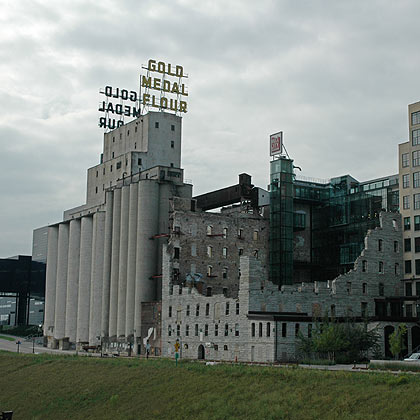
And what a museum. It was just closing when we got there, but we returned the next morning for a full tour of the museum and the Mill Ruins Park. The highlight of the museum is an elevator tour of the mill as it was back in the early 20th century. They load 30 people at a time into a giant freight elevator, which takes the group up to the 8th floor of the museum, stopping at floors along the way to view and hear scenes from the mills workings, narrated by former mill workers. After the elevator tour, you’re directed to an outdoor deck on the 9th floor, where you can view the shell of the mill building, St. Anthony Falls, the Stone Arch Bridge, the Gold Medal Flour sign, and the rest of the historic area.
Meyer, Scherer & Rockcastle are the architects responsible for the project, and they deserve all the accolades they get from one of the most unique museums I’ve ever been to. The statement from the American Institute of Architects jury explains the design of the museum:
A creative adaptive reuse of an extant shell of a mill building, with contrasting insertion of contemporary materials, weaving the old and the new into a seamless whole…A complex and intriguing social and regional story that reveals itself as the visitor progresses through the spaces. It is museum as a verb…A gutsy, crystalline, glowing courtyard for a reemerging waterfront district that attracts young and old and has stimulated adjacent development.
I still can’t quite believe they turned my favorite Minneapolis building (of all buildings) into a museum….and that it was done so well. More than anything, I’m happy and relieved that the Gold Medal Flour Building will always be there when I go back to visit. If you’re ever in Minneapolis, do yourself a favor and check it out.
Photos on Flickr tagged “mill city”
Photos on Flickr tagged “mill city museum”
Mill City: A Visual History of the Minneapolis Mill District was helpful in writing this post
A Washington Post review of the museum from September 2005
The new Guthrie Theater is right next door and is a dazzling building in its own right (photo, more photos)
Yikes, the Shake Shack failed their recent health inspection….and bad.
Bijou Phillips shows everyone her bag of tricks. May be NSFW. (thx, dj)
The CSM reviewed a book called Special Topics in Calamity Physics by Marisha Pessl last week, saying if you like Eggers and footnotes (a la Clarke’s Strange & Norrell or, presumably DFW), you might like this one. Anyone read this? Worth a shot?
I may be able to use macro filters on an existing lens instead of getting a new macro lens for my D70 in shooting through the viewfinder of the Duaflex. Investigating…
Update: Chris and Dooce are experimenting with TTV as well.
Cripes, Hasselblad makes a 39 megapixel digital camera. Cost: around $30,000. (via yp)
Google is not starting to become concerned about their name being used as a generic verb meaning “to search”; they’ve been concerned for more than 3 years (more here). This movement to expose Google as big, dumb, and humorless strikes me as big, dumb, and humorless.
Design Observer has a suggested alert system for the avian flu.
Quick review of the Nikon D80, the successor to the popular prosumer D70 SLR. 10 megapixel, but still no wifi.
Rare rave for M. Night Shyamalan’s Lady in the Water, which was demolished by the critics.
Public acceptance of evolution is relatively low in the US and is getting lower. “American Protestantism is more fundamentalist than anybody except perhaps the Islamic fundamentalist.”
Update: Here’s a graph of the results. Yikes.
Bruce Schneier on the liquids ban at the airport and “the difference between effective security and security theater”. “And if you want to know what you can do to help? Don’t be terrorized.”
The Observer lists 15 web sites that changed the world, including Google, Wikipedia, Blogger, and Amazon. (thx, dylan)
I picked up a Kodak Duaflex II camera at an antique store this weekend. I’m going to use to it do some through the viewfinder shots with the D70. The idea is that you take a photo of the Duaflex viewfinder with the SLR camera, thereby picking up all the spots, scratches, and curves of the old lens. A lens hood is required to block unwanted light reflections. Here’s a tutorial describing the process. Of course, it was after I bought the Duaflex that I discovered the need for a different lens on the SLR to make it work properly. We’ll see if the 50 mm lens at home works. Some results soon. Hopefully.
Apologies for the lack of posts over the last couple of days. I’m back in the midwest visiting my folks. I’m doing great; they have sausage shaped like beer bottles here!
Another article on the decline of the baseball card industry in the US. “Why does a kid want a baseball card of a player when, with a joystick, he can be that player in a video game?” (thx, peter)
Satellites measuring the earth’s gravity from orbit detected a change in gravity from the massive earthquake that caused the tsunami in the Indian Ocean. “The gravity at the earth’s surface decreased by as much as about 0.0000015 percent, meaning that a 150-pound person would experience a weight loss of about one-25,000th of an ounce.”
Lifehacker has a great thread going about how to find cheap airline travel, online and off. Going through a travel agency situated in a neighborhood populated by people from the location you’re travelling to is a great tip.
Anil Dash writes that “intellectual dishonesty is a powerful tool, and should only be used in service of important and valuable causes”. He and I have argued about this before so I think he’s being serious (and not just being intellectually dishonest), but I think that statement is pure horse plop.
Rebecca Blood posted the interview she did with me for her Bloggers on Blogging series. It’s a nice change of pace to be interviewed about blogging by someone who knows as much or more than I do about it.
Kevin Burton looks at the Technorati “data” and discovers that since the number of daily postings is growing linearly, the number of active blogs is probably growing lineary too…which means that the exponential growth of the blogosphere touted repeatedly by Technorati and parroted by mainstream media outlets is actually the growth of dead blogs.
Video of Travis Pastrana performing a double backflip on a motorcycle, the first time it’s been landed successfully in competition.
L.C. Hall wrote an article in 1902 for McClure’s Magazine called “Telegraph Talk and Talkers, Human Character and Emotions an Old Telegrapher Reads on the Wire”. Hall’s article reveals a surprisingly wide range of information transmitted across telegraph wires between operators that has nothing to do with the messages being sent.
The piece begins with an account of a “fast sending tournament”, which contest reveals not only the quick sender, but the masterful:
Presently a fair-haired young man takes the chair, self confidence and reserve force in every gesture. Away he goes, and his transmission is as swift and pure as a mountain stream. “To guard against mistakes and delays, the sender of a message should order it repeated back.” The audience, enthralled, forgets the speed, and hearkens only to the beauty of the sending. On and on fly the dots and dashes, and though it is clear that his pace is not up to that set by the leaders, nevertheless there is a finish — an indefinable quality of perfection in the performance that at the end brings the multitude to its feet in a spontaneous burst of applause; such an outburst as might have greeted a great piece of oratory or acting.
Many friendships were formed over the wire between senders who, judging mainly by the cadence of the code, sized up their counterparts from hundreds of miles away to the point of knowing their gender and general demeanor despite having never asked. Hall struck up such a friendship with a man called C G, whose attachment to Morse and Hall was so strong that he called out for him on his deathbed:
“Late in the evening,” said the [head nurse] as our interview was ending, “I was called into his room. He was rapidly failing, and was talking as if in a dream, two fingers of his right hand tapping the bedclothes as if he were sending a message. I did not understand the purport, but perhaps you will. ‘You say you can’t read me?’ he would say; ‘then let H come to the key. He can read and understand me. Let H come there, please.’ Now and again his fingers would cease moving, as if he were waiting for the right person to answer. Then he would go on once more: ‘Dear me, dear me, this will never do! I want to talk with H. I have an important message for him. Please tell him to hurry.’ Then would follow another pause, during which he would murmur to himself regretfully. But at last he suddenly assumed the manner of one listening intently; then, his face breaking into a smile, he cried, his fingers keeping time with his words: ‘Is that you, H? I’m so glad you’ve come! I have a message for you.’ And so, his fingers tapping out an unspoken message, his kindly spirit took its flight.”
The article closes with a bit on telegraph slang, or “hog-Morse”, when inexperienced operators slip up and send a bit of jibberish that expert receivers can nonetheless decipher from the context.
In the patois of the wires “pot” means “hot,” “foot” is rendered “fool,” “U. S. Navy” is “us nasty,” “home” is changed to “hog,” and so on. If, for example, while receiving a telegram, a user of the patois should miss a word and say to you “6naz fimme q,” the expert would know that he meant “Please fill me in.” But there is no difficulty about the interpretation of the patois provided the receiver be experienced and always on the alert. When, however, the mind wanders in receiving, there is always danger that the hand will record exactly what the ear dictates. On one occasion, at Christmas time, a hilarious citizen of Rome, New York, telegraphed a friend at a distance a message which reached its destination reading, “Cog hog to rog and wemm pave a bumy tig.” It looked to the man addressed like Choctaw, and of course was not understood. Upon being repeated, it read, “Come home to Rome, and we’ll have a bully time.” Another case of confusion wrought by hog-Morse was that of the Richmond, Virginia, commission firm, who were requested by wire to quote the price on a carload of “undressed slaves.” The member of the firm who receipted for the telegram being something of a wag, wired back: “No trade in naked chattel since Emancipation Proclamation.” The original message had been transmitted by senders of hog-Morse, called technically “hams,” and the receivers had absent-mindedly recorded the words as they had really sounded. What the inquirer wanted, of course, was a quotation on a carload of staves in the rough.
Hog-Morse reminds me of the SMS typos which occur when T9 slips up or someone fat-fingers the wrong button on the phone. I can’t recall how many times I’ve texted my wife “good soon”, by which I meant that I’ll be “home” shortly. It’s also reminiscent of gamer typo slang, like pwned, teh, and su[.
For more on the telegraph, particularly as it relates to contemporary communication technology, I highly recommend The Victorian Internet by Tom Standage. Also related: send Morse code via SMS with your mobile phone and a 23-yo woman from Singapore holds the world record for speed texting a 26 word message in 43 seconds.
Update: The texting record was broken in July; a Utah teen texted the message in 42.22 seconds. And in an Australian speed contest, a telegraph operator beat texting teens. (thx eugene and alex)
Why a roundabout in Cleveland isn’t doing a good job calming traffic. More on traffic calming.
A list of “cool slang” and “cyber slang”. Now you greppers can slide the talkways with your thread sled while frying some screens and avoiding the Stiks. It’ll be slammatocious!
Here’s a video of Snoop Dogg listening to and singing along with a country-style cover of Gin and Juice by The Gourds.
Last week, Vanity Fair published an article about the U.S. Air Force’s response to 9/11. In writing the article, Michael Bronner makes extensive use of audio tapes from the control room of NORAD’s Northeast headquarters and in the online version, you can listen to audio clips of those tapes. As you can see in the screenshot below, not only are the transcripts of the audio part of the main narrative (and not collected elsewhere or put into a separate footnote or sidebar), but the controls for playing the audio clips (PLAY | STOP) are presented inline as well:
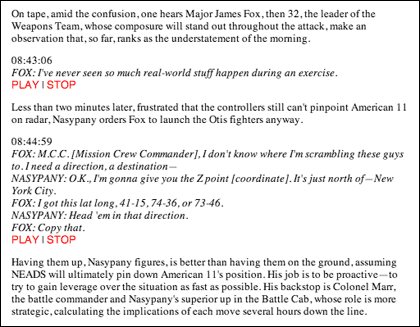
That’s a nice bit of design. No need for a clunky player or to download the clips at the end of the article when two simple text-only inline commands will do. In Beautiful Evidence, Edward Tufte argues for the placement of information in the location where it will do the most good for those attempting to understand the matter at hand, regardless of form:
Evidence is evidence, whether words numbers, images, diagrams, still or moving. It is all information after all. For readers and viewers, the intellectual task remains constant regardless of the particular mode of evidence: to understand and to reason about the materials at hand, and to appraise their quality, relevance, and integrity.
The examples that Tufte cites in the book are all visual and published on paper. This is an instance where web publishing provides for a better way to design for the information at hand than print. (thx to david for kickstarting this post)
A Kevin Smith signing in New Jersey lasted 13 hours (until 4am); they expected around 200 people but over 2000 showed up.
Jesus Camp is a forthcoming documentary about a camp in North Dakota “where kids as young as 6 years-old are taught to become dedicated Christian soldiers in God’s army”. David Byrne has a review: “One asks if religious visions are better off kept as a personal thing, or at least confined to a small group — otherwise the death and destruction sown by and in the name of religions more or less balances out their moral and personal virtues.”
Socials & More