Entries for July 2006
MotherLoad. Sure, it starts off simple enough. Oh, it’s like Dig Dug, cute. Collect the ore, exchange it for money, and ooh, upgrades! There’s platinum down here. Rubies! Wait, it’s almost dinnertime? But we just had lunch. That was 5 hours ago? Oh. No. (This is why I can never, ever play Warcraft. Meg would be widowed for sure. “Jason is survived by his wife, Meg, and was preceded in death by his former self…”)
John Battelle heard that YouTube is worth $1 billion and calls bullshit on whoever believes that. As Tim Shey notes, lots of people are comparing YouTube to Napster (except for YouTube, of course), and I think the comparison is apt. Both services have potentially infinite intangible value but little business value.
I Like Killing Flies is a 2004 documentary about Shopsin’s, a unique NYC eatery. Playing at NYC’s Cinema Village this coming weekend. See also Shopsin’s menu design and Calvin Trillin’s classic NYer piece.
Motorized scooters, ostensibly for the handicapped, are finding a new audience: the lazy. “When scooter demand outstrips supply at Wal-Mart, greeters ‘evaluate the situation’ and make sure that people using the scooters can demonstrate a legitimate need.”
Two weeks in Ukraine with 30 men hunting for brides. “The vision was Madonna and puttana rolled together, an American male desire shaped in equal parts by the Promise Keepers and Internet porn.” (via maciej)
Profile of Floyd Landis, who won the Tour de France yesterday. (via, a.whole)
Jesse James Garrett talks with Steven Johnson about Interface Culture. I know part 2 is coming, but I just want this interview to go on forever. p.s. Dean!
I could read interviews of Errol Morris all day long. “It became obvious that I was never going to be able to knock on the door of someone who’s committed some massive insurance fraud and stick a camera in their face and get them to talk. It’s never going to happen. The best you can expect is getting the shit kicked out of you.”
The Independent has a great infographic on its cover today depicting which countries support the immediate ceasefire in the Middle East demanded by the UN and which do not:
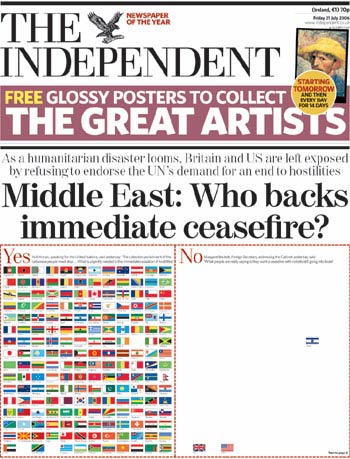
That message would take up less space as words, but somehow the impact wouldn’t be quite the same. (thx, g)
Jeff Bezos invests in 37signals, making them bigger and a little less Real. But seriously, I had always wondered how 37s was going to grow and this is a bit of an answer to that question. Congrats, guys. (thx, steve)
Update: Tom has some thoughts on Bezos’ next investments, most likely 31functions.com, 25description.com, and 19options.com.
Beautiful Evidence is both the title of Edward Tufte’s latest book and an accurate description of the document itself. Like few other mass market publications, BE is lovingly hand-crafted, a physical manifestation of the ideas expressed in its pages; the text and images therein could be about another subject entirely and you might still get the point: “Words, Numbers, Images - Together” (the title of the book’s fourth chapter).
Case in point. Pages 123 and 124 fold out into a spread depicting Charles Joseph Minard’s famous infographic of the disastrous 1812 invasion of Russia by France. But unlike most magazine and book fold-outs, the page that folds out is cut 1/2 inch narrower than the underlying page so that a) a bit of the page underneath peeks out, providing a visual cue for unfoldability, and b) there’s no difficulty when you go to refold the page with getting it caught in the book’s crease or otherwise undesirably bending/creasing it. The fold-out design is a small thing that the casual reader might not even notice, but it demonstrates the care that went into the production of the book (and perhaps the reason why Tufte took so long in writing/designing it).
The gang at 37signals noticed similar craftsmanship in the writing and presentation:
“What struck me is how you almost never have to hold something in your head while turning the page…he usually finishes his thought within the two pages you can see…and when you flip, it’s something new…that’s an excellent self-imposed constraint…’whatever i need to say, i’ll do it here.’” Jason replied, “Yes, I love that. I noticed that more on this book than others. The image and text is in one spread so when you turn you are turning your attention to a new idea. If you have too much to say than the space allowed then you are probably saying too much…it definitely makes it easier to design the book too…you can design each spread as if it was a standalone poster.”
What I’ve also noticed about Beautiful Evidence is the lack of reviews in mainstream publications; I can’t find a single newspaper or magazine that has published a review. Compare that to the releases of Gladwell’s Blink, Remnick’s Reporting, and Anderson’s The Long Tail, for which reviews started appearing almost everywhere before the books were even available. Those books were written for mass audiences and backed by large publishing companies with ample PR resources and plenty of review copies to go around. In contrast, Beautiful Evidence is self-published by Tufte, which means it’s beautiful, personal, and done just right, but also invisible to the mainstream press. Not that Beautiful Evidence is being ignored — the blogosphere is talking about it and the Amazon Sales Rank is currently about 600 (which doesn’t count online sales directly from edwardtufte.com) — but it deserves the consideration of the mainstream press.
Boing Boing has information on YouTube’s recently revised Terms and Conditions, which now state that they can use uploaded video for pretty much anything they want. For some users, that may be a steep price to pay for “free” bandwidth. The longer term question is, can YouTube find a business model that won’t completely screw up their wonderful offering or will they ultimately go the way of Napster?
A West Village family built a porch and garden on top of their six floor apartment building. The photos are surreal. “The depth [of the soil] was kept consistent because Mr. Puchkoff had the foresight to collect two dozen chopsticks from Sushi on Hudson, a Japanese restaurant in the neighborhood, and mark them at seven inches.”
Disney panicked when they saw Johnny Depp’s approach to playing Captain Jack Sparrow in Pirates of the Caribbean, even though it eventually made the film a huge success. “‘Look, you hired me to do the gig. If you can’t trust me, you can fire me. But I can’t change it.’ It was a hard thing to say, but fuck it.” Didn’t work so well for Charlie and the Chocolate Factory though… (via mike)
The NY Times on the state-of-the-art in book self-publishing. Prices are dropping (slightly), quality and options are increasing.
The secret to wisdom: strong opinions, weakly held. “Bob explained that it was just as important, however, to not be too attached to what you believe because, otherwise, it undermines your ability to ‘see’ and ‘hear’ evidence that clashes with your opinions.” (via mike)
Update: J.P. Taylor wrote about “extreme views weakly held” in 1977. (thx, rich)
Unnecessary censorship video. Brilliant take on how ridiculous the whole TV censorship thing is. (via cyn-c)
Are large cities, both culturally and economically, turning into their own countries? “The most important place to London is New York and to New York is London and Tokyo. London belongs to a country composed of itself and New York.” Like many residents, it often seems like NYC isn’t a part of the rest of the US.
One of the most enjoyable presentations at Taste3 was by mad scientist David Arnold, who made gin and tonic onstage, but without the tonic. (He added the fizz directly to the gin with a CO2 canister.) Pete Wells recently profiled Arnold in Food & Wine magazine. And here’s an article from IT World.
Thanks to the glories of YouTube, you can now watch Kaj Pindal’s Oscar-nominated short film, What On Earth!:
Made in 1966 under the auspices of the National Film Board of Canada, the animated film records a visit by Martians to Earth and their observations about the planet’s dominant life form, the automobile.
World Jump Day is tomorrow. “Join us in the attempt to drive Planet Earth into a new orbit.”
Because of the current conflict between Israel and Hezbollah, the Rapture Ready/End Times Chat board is buzzing with excitement over what the board’s denizens believe may be the second coming of Christ. “This is the busiest I’ve ever seen this website in a few years! I have been having rapture dreams and I can’t believe that this is really it! We are on the edge of eternity!!!!!!!!!!!!!!!!!!!!!!”
This tshirt with infographics on it is too nerdy even for me. That and I’ve been getting a ton of crap from everyone I know about how many Threadless tshirts I own.
One of the first reviews Ruth Reichl wrote as the New York Times food critic was of Le Cirque, a fancy French restaurant in midtown Manhattan. In the now-famous piece, immortalied in her memoir, Garlic and Sapphires, Reichl compares the service she receives at the restaurant as a welcomed reviewer with that as an average Jane. From the review:
Over the course of five months I ate five meals at the restaurant; it was not until the fourth that the owner, Sirio Maccioni, figured out who I was. When I was discovered, the change was startling. Everything improved: the seating, the service, the size of the portions. We had already reached dessert, but our little plate of petit fours was whisked away to be replaced by a larger, more ostentatious one. An avalanche of sweets descended upon the table, and I was fascinated to note that the raspberries on the new desserts were three times the size of those on the old ones.
Thirteen years later, current food critic Frank Bruni reviews the newest incarnation of Le Cirque in today’s Times and echoing Reichl’s technique, finds that little has changed:
I also experienced Le Cirque’s famously split personality, half dismissive and half pampering, depending on who you are. On my first visit, when a companion and I arrived before the two other members of our party, a host let us know we should wait in the bar area not by asking or telling us to go there but by gesturing silently in that direction with his head. Most of the seats were occupied, so we stood. Over the next 10 minutes, no one asked us if we wanted a drink or anything else.
After we were taken to our table, servers seemed to figure out who I was and offered to move us to prime real estate with better sightlines. (We declined.)
So on a subsequent visit I sent three friends in ahead of me. One sat at the bar for 15 minutes without getting a server’s attention, and a bartender quarreled with the two others when they asked that the charges for their Champagne be transferred to the table. At a place as self-consciously posh as Le Cirque, such a request should be granted instantly.
But I was treated like royalty when I showed up, and on another night, when I dined with a filmmaker whom the staff also knew, soft-shell crabs, which weren’t on the menu, appeared almost as soon as she mentioned an appetite for them. They were fantastic: crunchy, meaty, sweet.
I can’t imagine wanting to go someplace like that when there’s so many other places with food as good or better and where the service is friendly, helpful, and accommodating for everybody. I guess that’s the side of New York I don’t like.
Here it is, the awful truth. After sampling In-N-Out Burger twice this past weekend (a cheeseburger with raw onion and, 4 days later, a Double Double w/ no onions) and having had several Shack Burgers this year (my most recent one was a couple of weeks ago), an adequate comparison between the two can be made. The verdict?
The Shake Shack burger wins in a landslide. It’s more flavorful, features a better balance of ingredients, and a yummier bun. On the french fries front, In-N-Out’s fresh-cut fries get the nod.
Courtesy of Mena, something to keep in mind: a cheeseburger at In-N-Out is $1.85 while a similarly appointed Shack Burger is $4.38, almost 2.5 times as much. SS french fries are nearly twice the price of In-N-Out fries. The burger comparison is an unfair one because, despite its location and style, Shake Shack is a restaurant and In-N-Out is a fast food joint. That the burgers are even close enough to compare — and make no mistake, I still love the In-N-Out burger — says a great deal about In-N-Out.
Back in 9/2000, over a hundred bloggers recorded their day in photos and text…alas, most of those galleries are gone; only the listings remain. It’s funny, bloggers are their own paparazzi and archivists, but they’re not doing a very good job of it; there’s little material publicly available from those early days.
Stop-motion human Space Invaders. The must-see video game and stop-motion video related link of the day. (thx, janelle)
Update: This looks like the official site.
Yet another take on the Zidane headbutt, this time from Dany Laferriere (translated by Rana Dasgupta). “I don’t believe that the Italian player said to him anything that he couldn’t stand to hear. He simply felt that this was the moment. His last match, the finale of the World Cup, at the very end. It was now or never. Otherwise, he had sold himself for good.”
On the heels of two books critical of string theory, a look at the string theory backlash.
During the depths of the dot com bust, Julian Dibbell looked online for a job and found one as a commodities trader in the Ultima Online virtual world. During one particularly productive month, he made almost US$4000. Dibbell has a book coming out about the experience, Play Money: Or, How I Quit My Day Job and Made Millions Trading Virtual Loot. In addition to being available at bookstores in meatspace, Play Money will also be on sale in the virtual world of Second Life in the currency of that world (Linden dollars). From the press release:
In-game versions of Play Money designed by Second Life coder/publisher Falk Bergman are available for L$750. These copies can be signed by Dibbell at his in-Second Life interview with journalist Wagner James Au on July 27th. For the Second Life resident who needs something a bit more tactile, L$6250 buys a real-life copy of Play Money, shipped with care to the buyer’s real life address, in addition to the standard in-game version.
(At the time of this press release, Linden dollars are trading at approximately L$300.00 to the US$1.00. Adjusted to US dollars, an online copy costs US$2.50, and the price of a real-life copy bought in-game is around US$20.85.)
Dibbell will be signing his virtual books in Second Life on July 27th. Caterina read Play Money and has some thoughts on its relation to her work/play at Ludicorp. And here’s a preview of Chinese Gold Farmers, a documentary on gold farming sweatshops in China.
Profile of Brian Burton, aka Danger Mouse, aka half of Gnarls Barkley. “[Burton] wants to be the first modern rock ‘n’ roll auteur, mostly because he understands a critical truth about the creative process: good art can come from the minds of many, but great art usually comes from the mind of one.”
Newer posts
Older posts





Socials & More